
Many people think of chiropractic care as a way to relieve neck pain, back pain, or stiffness. An adjustment may improve movement and reduce symptoms—and for some patients, that may be exactly what is needed.
But after a motor vehicle collision, there is a more important question:
Did the accident simply make the spine painful, or did it change the way the spine is aligned, loaded, and stabilized?
That distinction matters.
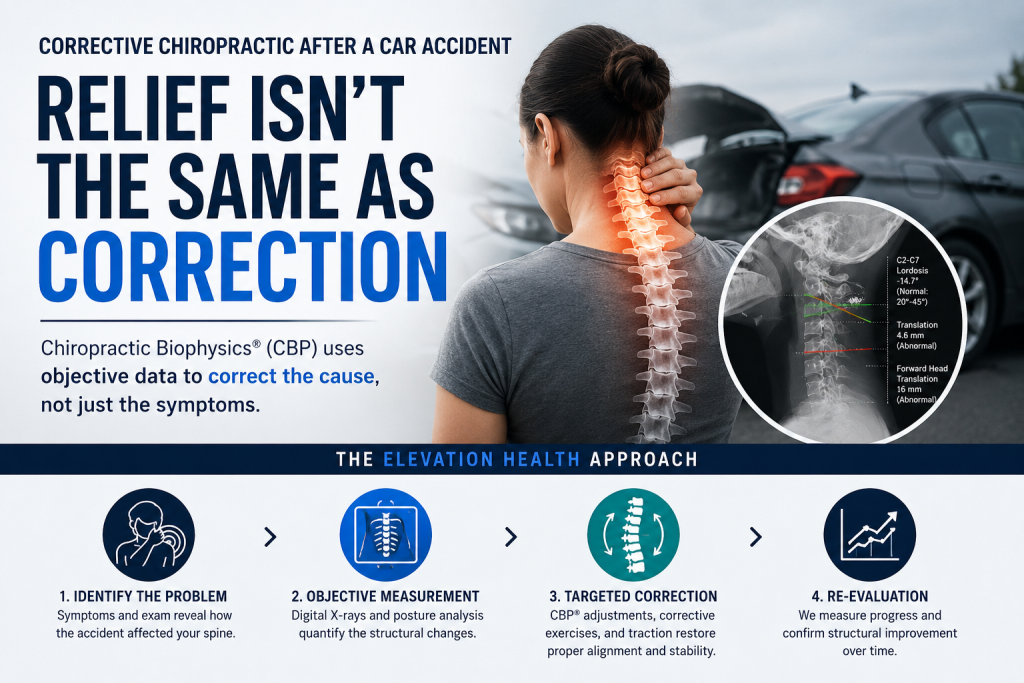
At Elevation Health, corrective chiropractic after a car accident is designed to look beyond symptoms. Using principles of Chiropractic Biophysics® (CBP), care focuses on objective measurements of spinal alignment and posture, identification of abnormal biomechanics, and a corrective plan based on what the evaluation actually shows.
The goal is not simply to make a patient feel better temporarily. It is to understand what changed—and determine whether those changes can be corrected.
Why a Car Accident Can Change Spinal Biomechanics
During a collision, the head and body can accelerate and decelerate rapidly. In a whiplash-type injury, these forces may place substantial stress on the joints, muscles, discs, and supporting ligaments of the cervical spine.
The result is not identical in every patient.
Some people primarily experience soft-tissue pain and recover relatively quickly. Others may develop measurable changes in posture, spinal alignment, joint mechanics, or stability.
After an accident, an evaluation may identify findings such as:
- Loss or alteration of the normal cervical curve
- Forward head translation
- Abnormal spinal alignment
- Altered joint mechanics
- Ligament injury or instability
- Compensatory postural changes
This is one reason a one-size-fits-all approach to post-accident chiropractic care may be inadequate.
The treatment should follow the injury—not the other way around.
Pain Relief and Structural Correction Are Not the Same Thing
Pain is important, but pain alone does not tell us everything about an injury.
A patient can feel better while abnormal biomechanics remain. Conversely, structural abnormalities on imaging do not automatically prove that they are responsible for a patient’s symptoms.
Broad diagnoses may not always identify the specific tissues involved, which is why terms like sprain and strain after a car accident should be considered alongside the patient’s clinical and imaging findings.
That is why corrective chiropractic after a car accident should begin with a comprehensive evaluation rather than assumptions.
Traditional chiropractic treatment often emphasizes restoring joint motion and reducing symptoms. Those goals can be valuable. However, when an examination identifies measurable postural or structural abnormalities, improving mobility alone may not address the entire problem.
The relevant questions become:
What was injured? What changed mechanically? Is the spine stable? And what findings are actually correctable?
Chiropractic Biophysics Uses Objective Measurements
A defining feature of Chiropractic Biophysics is its emphasis on quantifying spinal posture and alignment rather than relying exclusively on symptoms or visual observation.
When clinically appropriate, digital X-rays can be analyzed to measure spinal alignment and compare those measurements with established biomechanical models.
Depending on the patient’s findings, this analysis may evaluate:
- Cervical and lumbar curvature
- Head translation
- Vertebral alignment
- Postural displacement
- Mechanical relationships between spinal regions
These measurements provide a baseline.
Instead of simply asking whether a patient feels better, corrective care can also ask:
Did the measurable biomechanical finding actually change?
That distinction is central to the Elevation Health approach.
Imaging Is Only One Part of the Diagnosis
X-rays can provide valuable information about spinal alignment, but no single imaging study tells the entire story.
A proper evaluation after a car accident requires clinical correlation—combining the patient’s history, mechanism of injury, symptoms, examination findings, and appropriate diagnostic imaging.
Standard X-rays are useful for evaluating bone/vertebral alignment and certain structural findings.When symptoms or examination findings suggest a deeper structural injury, understanding when an MRI is needed after a crash can help determine whether additional imaging is appropriate. In selected cases, additional imaging may be needed when ligament injury or instability is a concern.
This is particularly important because a patient can have persistent symptoms even when a conventional static study does not explain them completely.
The objective is not to order more imaging for everyone.
It is to use the right diagnostic tool for the right clinical question.
How CBP Corrective Care Works
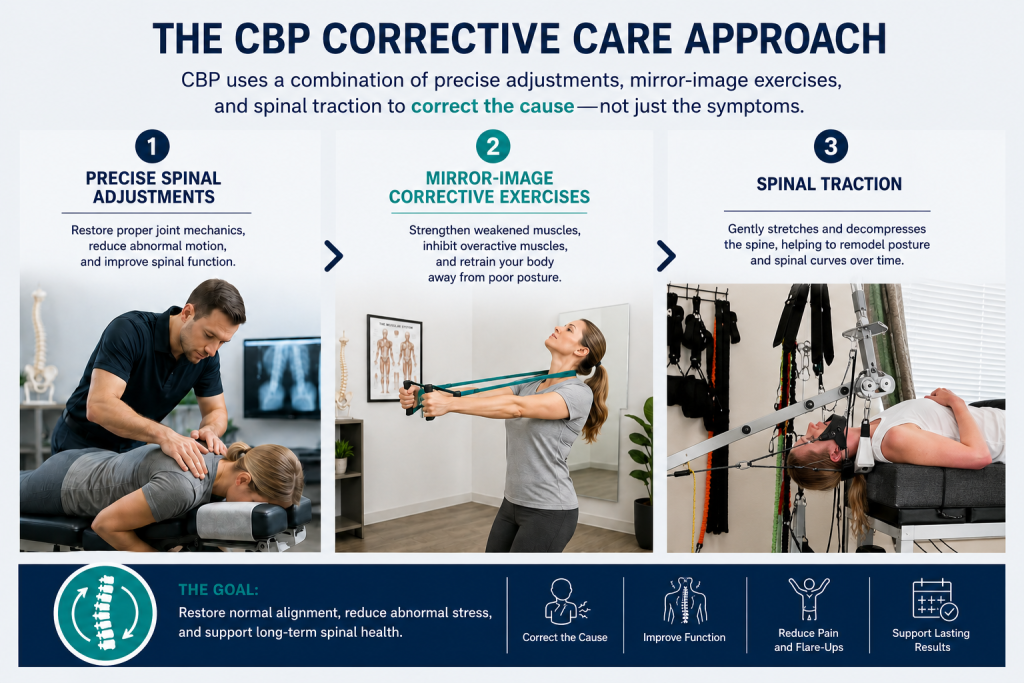
When the evaluation identifies a biomechanical problem appropriate for corrective care, Chiropractic Biophysics may use several complementary methods. CBP corrective care combines targeted adjustments, mirror-image exercises, and cervical extension traction to address measurable structural abnormalities. (3)
Precise Chiropractic Adjustments
Adjustments may be used to improve joint mechanics and address specific spinal dysfunction identified during the examination.
Mirror-Image Exercises
Corrective exercises are designed around the patient’s postural displacement. Rather than using the same exercises for everyone, the objective is to train the body away from the measured abnormal posture.
Corrective Spinal Traction
Traction is one of the features that most clearly distinguishes CBP corrective care from adjustment-only chiropractic.
Corrective traction applies sustained, controlled forces intended to influence spinal posture and alignment over time. The treatment parameters are selected according to the patient’s measured structural findings.
This is fundamentally different from repeatedly treating the location where a patient happens to hurt.
Why Re-Evaluation Matters
A corrective treatment plan should be testable.
If the original evaluation identifies measurable abnormalities and treatment is intended to change them, those findings should eventually be measured again.
At Elevation Health, re-evaluation helps answer two separate questions:
Has the patient improved clinically?
and
Have the objective findings improved?
Those are related questions, but they are not identical.
Re-evaluation may include changes in symptoms, function, examination findings, posture, and—when clinically justified—objective spinal measurements.
This creates accountability for the treatment plan.
We don’t simply assume correction occurred. We measure the outcome.
Why This Matters After Whiplash
Whiplash is often described as though it were a single injury. In reality, similar symptoms can arise from different injured structures.
One patient may primarily have muscular injury. Another may have facet joint involvement. Another may have disc injury, ligament damage, altered alignment, or some combination of these findings.
That is why the label “whiplash” by itself does not determine the appropriate treatment.
For patients with persistent symptoms, identifying spinal instability or other measurable biomechanical abnormalities can substantially change the treatment strategy.
When instability is suspected, the clinical priority may be very different from treating an uncomplicated restriction in joint motion.
Motor vehicle collisions can alter cervical alignment, and corrective rehabilitation may help restore the cervical curve toward its pre-injury alignment. (2)
When trauma damages the structures responsible for controlling spinal motion, understanding spinal instability after an auto accident can be important when determining the appropriate treatment strategy.
Corrective Care Should Not Be One Size Fits All
Not every person injured in a collision needs an extensive corrective program.
That point is important.
The purpose of objective evaluation is not to put every patient through the same protocol. It is to determine who actually has findings that warrant corrective care.
A patient whose primary problem is acute soft-tissue irritation may require a different strategy from someone with measurable postural displacement, structural change, neurological involvement, or suspected ligament instability.
For patients with chronic neck pain and measurable cervical kyphosis (reversed neck curve), corrective rehabilitation aimed at improving cervical lordosis (normal neck curve) has been associated with improvements in pain, disability, and spinal alignment. (1)
At Elevation Health, treatment recommendations are based on the individual patient’s findings rather than a predetermined number of visits or adjustments.
If you’re still experiencing symptoms after a collision, learn more about our Auto Accident Care approach and how we evaluate injuries, identify biomechanical changes, and develop an individualized treatment plan.
The Elevation Health Approach
For patients injured in motor vehicle collisions, Elevation Health approaches chiropractic care as part of a broader diagnostic and biomechanical process.
That process may include:
- Detailed accident and health history
- Orthopedic and neurological examination
- Postural and biomechanical assessment
- Appropriate diagnostic imaging
- Objective spinal measurements
- Individualized corrective treatment
- Re-evaluation of clinical and structural outcomes
This allows treatment to progress from diagnosis → measurement → correction → re-evaluation.
It also gives patients a clearer explanation of what was found, why a particular treatment is being recommended, and how progress will be evaluated.
Who May Benefit From Chiropractic Biophysics?
CBP-based corrective care may be appropriate for patients who have measurable biomechanical or postural abnormalities and whose clinical findings indicate that structural correction should be part of their treatment plan.
This can include some patients who:
- Continue to experience neck or back symptoms after a car accident
- Have persistent headaches associated with cervical dysfunction
- Demonstrate abnormal spinal alignment or posture
- Have recurring symptoms despite previous symptom-based care
- Require a more objective assessment of spinal biomechanics
- Want progress evaluated using measurable findings
Whether CBP is appropriate should ultimately be determined by the examination—not simply by the presence of pain.
Beyond Temporary Relief
The strongest argument for Chiropractic Biophysics is not that every patient needs more chiropractic care.
It is that patients deserve care matched to the problem actually identified.
After a car accident, symptom relief can be an important part of recovery. But when trauma has produced measurable changes in spinal biomechanics, treating symptoms alone may leave an important part of the injury unaddressed.
At Elevation Health, corrective care begins by identifying and measuring the problem, developing an individualized treatment strategy, and re-evaluating the findings to determine whether meaningful change has occurred.
Relief matters. But when correction is indicated, relief should not be the only thing we measure.
Ready to Move Beyond Temporary Relief?
If you’re still experiencing neck pain, headaches, stiffness, or other symptoms after a car accident, the next step is understanding why those symptoms persist. Elevation Health uses objective spinal measurements and Chiropractic Biophysics (CBP) principles to determine whether structural or biomechanical changes may be contributing to your symptoms.
Schedule an evaluation at Elevation Health to find out whether corrective chiropractic after a car accident is appropriate for you.
References
- Oakley PA, Ehsani NN, Moustafa IM, et al. — “Restoring cervical lordosis by cervical extension traction methods in the treatment of cervical spine disorders: a systematic review of controlled trials.” Journal of Physical Therapy Science, 2021.
- Oakley PA, et al. — “Positive Outcomes Following Cervical Extension Traction in Patients With Cervical Hypolordosis After Rear-End Motor Vehicle Collisions.” Journal of Clinical Medicine, 2023;12:6414.
- Norton TC, Oakley PA, Haas JW, Harrison DE — “Long-term stability of reducing cervical kyphosis via Chiropractic Biophysics extension traction procedures: a case series.” Journal of Physical Therapy Science, 2026.