
Advanced evaluation, evidence-based treatment, and objective documentation for injuries sustained in motor vehicle collisions.
Every motor vehicle collision is unique, but one principle remains the same: effective treatment begins with an accurate diagnosis.
Unlike many everyday injuries, auto accidents expose the body to rapid acceleration and deceleration forces that can affect multiple tissues simultaneously. Muscles, ligaments, intervertebral discs, facet joints, nerves, and supporting soft tissues may all be injured during the same event.
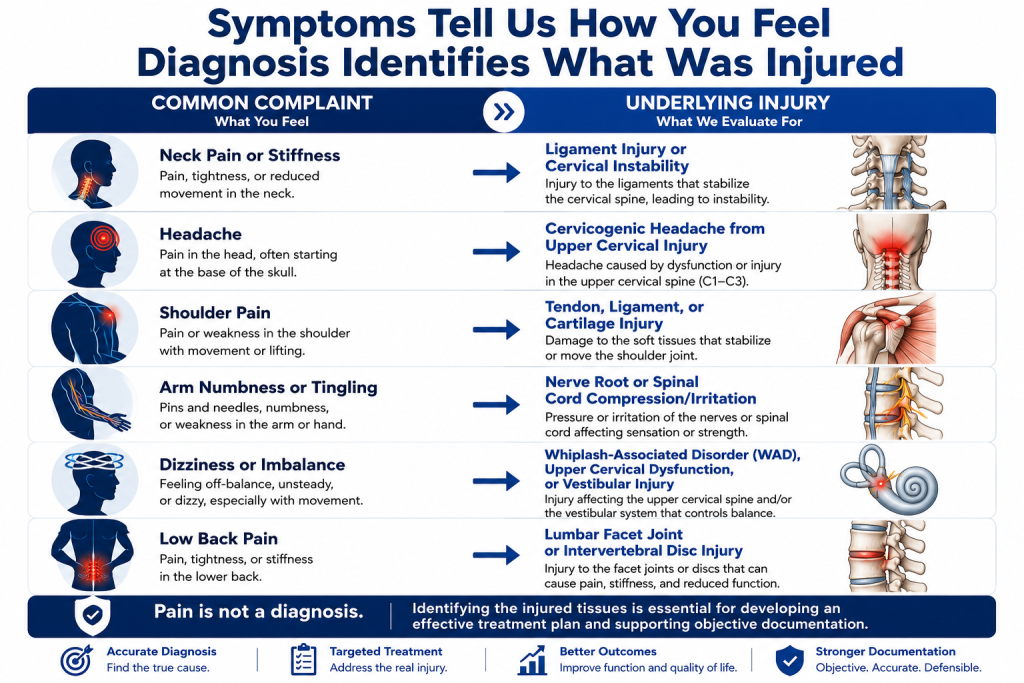
While fractures and severe injuries are often identified quickly, many patients experience persistent pain despite being told that their X-rays, CT scans, or MRI studies are “normal.” This occurs because standard imaging primarily evaluates anatomy while providing limited information about how the spine functions during movement.
Understanding the mechanism of injury, performing a comprehensive physical examination, reviewing imaging carefully, and determining whether additional diagnostic studies are appropriate are essential steps in identifying the source of persistent symptoms.
At Elevation Health, every evaluation is designed to answer one fundamental question:
What injury is causing your symptoms, and what objective findings support that diagnosis?
That answer forms the foundation for every treatment recommendation that follows.
Every patient responds differently after an auto accident, which is why no two evaluations should be exactly alike. Rather than focusing solely on where pain is located, a comprehensive evaluation seeks to determine which tissues have been injured, how they have been affected, and whether objective findings support the diagnosis.
A thorough assessment may include:
The goal is not simply to document symptoms—it is to identify the underlying cause of those symptoms so treatment can be directed toward the actual injury rather than temporary pain relief.
This systematic approach helps establish an accurate diagnosis, develop an appropriate treatment plan, and create objective clinical documentation that may also be valuable for other healthcare providers, insurance carriers, and legal professionals involved in the patient’s care.
Many patients receive general diagnoses such as “sprain” or “strain.” While these terms have specific medical definitions, they may not fully describe the injured tissues involved. Learn more in our Injury Education article: Why an Accurate Diagnosis Matters After an Auto Accident.
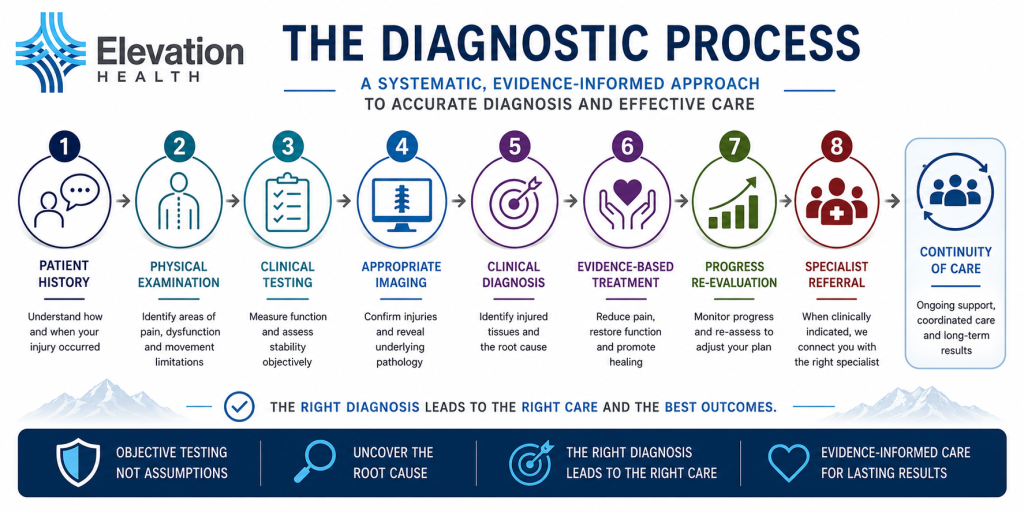
Each step builds upon the previous one. Information gathered during the patient’s history guides the physical examination, examination findings help determine whether additional imaging is necessary, and the combination of clinical findings and imaging results supports an accurate diagnosis.
By following a systematic diagnostic process, treatment decisions are based on objective clinical evidence rather than symptoms alone. This approach helps ensure that care remains focused, individualized, and appropriate for each patient’s unique injuries.
Every patient evaluation follows a structured clinical process designed to identify the source of injury and develop an evidence-based treatment plan.
Rather than focusing solely on pain relief, the evaluation seeks to answer several important clinical questions:
The answers to these questions guide every recommendation. By combining the patient’s history, physical examination, diagnostic imaging, and functional assessment, treatment decisions are based on objective clinical evidence rather than assumptions.
This systematic approach helps ensure that care is individualized, appropriate, and focused on restoring function while monitoring progress throughout recovery.
Diagnostic imaging plays an important role in evaluating injuries after a motor vehicle collision, but no single imaging study can identify every type of injury. Imaging findings must always be interpreted in conjunction with the patient’s history, physical examination, and clinical presentation.
Depending on the patient’s symptoms and examination findings, imaging may include:
It is also important to recognize that imaging findings do not always correlate with symptoms. Some patients experience significant pain despite minimal imaging abnormalities, while others may have age-related imaging findings that are unrelated to their current injury. For this reason, imaging should support—rather than replace—a comprehensive clinical evaluation.
Motor vehicle collisions can affect multiple structures within the spine and surrounding soft tissues. Although every patient presents differently, certain injury patterns are commonly associated with the rapid acceleration and deceleration forces experienced during an auto accident.
Conditions commonly evaluated include:
Not every injury is immediately visible after a collision, and symptoms may not develop until hours or even days later. A comprehensive clinical evaluation helps identify the injured tissues, correlate examination findings with diagnostic imaging, and guide appropriate treatment recommendations.
Effective treatment begins with an accurate diagnosis. Because no two injuries are exactly alike, treatment should be based on the specific tissues involved, the severity of the injury, the patient’s symptoms, and objective clinical findings.
Depending on the diagnosis, a comprehensive treatment plan may include:
Rather than applying the same treatment to every patient, care is individualized based on the diagnosis and the patient’s response throughout the recovery process.
The ultimate goal is not simply to reduce pain, but to restore function, improve quality of life, and help patients return safely to their normal daily activities.
Imaging is one piece of the diagnostic puzzle. The most accurate diagnosis comes from correlating the patient’s history, physical examination, and imaging findings rather than relying on any single test alone.
Recovery after an auto accident involves more than reducing pain. The goal is to restore normal movement, improve function, and support long-term spinal health while helping patients return to their daily activities as safely as possible.
Treatment recommendations are based on each patient’s diagnosis, clinical findings, and response to care. Depending on the nature of the injury, rehabilitation may include spinal rehabilitation, therapeutic exercise, postural correction, soft tissue therapies, and other evidence-informed treatment approaches designed to improve mobility, stability, and function.
When clinically appropriate, specialized rehabilitation methods such as Chiropractic BioPhysics® (CBP®) may be incorporated to address postural abnormalities and structural changes identified during the evaluation. These techniques are used as part of a comprehensive treatment plan—not as a one-size-fits-all approach—and are recommended only when supported by the patient’s clinical and imaging findings.
Throughout treatment, progress is monitored through periodic re-evaluation to ensure care remains appropriate and recovery continues to move in the right direction.
Accurate clinical documentation is an essential component of quality patient care following a motor vehicle collision. A thorough evaluation and precise diagnosis help communicate the nature of the injury, its severity, and the patient’s expected course of recovery.
Objective documentation provides a clear clinical record of:
This information helps ensure continuity of care when multiple healthcare providers are involved and supports informed clinical decision-making throughout the patient’s recovery.
When appropriate, objective clinical documentation may also facilitate communication with:
The primary purpose of documentation is to accurately reflect the patient’s condition, guide treatment decisions, and monitor clinical progress over time.
A precise diagnosis does more than identify an injury—it communicates the injury itself, its severity, and the patient’s expected clinical course. Accurate documentation ensures that this information is clearly understood by everyone involved in the patient’s care.
Yes. Standard imaging is excellent for identifying many injuries, but it does not detect every condition. Some soft tissue injuries, ligament injuries, and movement-related problems may not be apparent on routine imaging. A comprehensive clinical evaluation combines your history, physical examination, and imaging findings to develop an accurate diagnosis.
Yes. It is common for pain, stiffness, headaches, and other symptoms to develop hours or even days after a motor vehicle collision. Delayed symptoms do not necessarily indicate a minor injury. An evaluation can help determine whether additional assessment or treatment is appropriate.
Recovery varies depending on the type of injury, its severity, your overall health, and how quickly appropriate treatment begins. Some patients recover within a few weeks, while others require a longer period of rehabilitation. Your diagnosis and response to treatment help determine the expected course of recovery.
No referral is required. If your condition requires additional evaluation or treatment by another healthcare professional, appropriate referrals will made based on your clinical findings.
Accident information, insurance details, and a list of your current symptoms will be gathered at the time of your visit. These records help provide a more complete understanding of your injury and assist in developing an appropriate treatment plan.
Not every auto accident requires an attorney. Whether legal representation is appropriate depends on the circumstances of the collision, the severity of the injuries, questions regarding liability, and whether there are disputes involving insurance coverage or compensation.
The primary focus after any accident should be obtaining an accurate diagnosis and appropriate medical care. If legal questions arise during your recovery, you may wish to consult with an attorney who practices personal injury law to better understand your rights and options.
If you do not already have an attorney and would like assistance finding one, we can provide referrals to experienced personal injury attorneys whom we know and trust.