
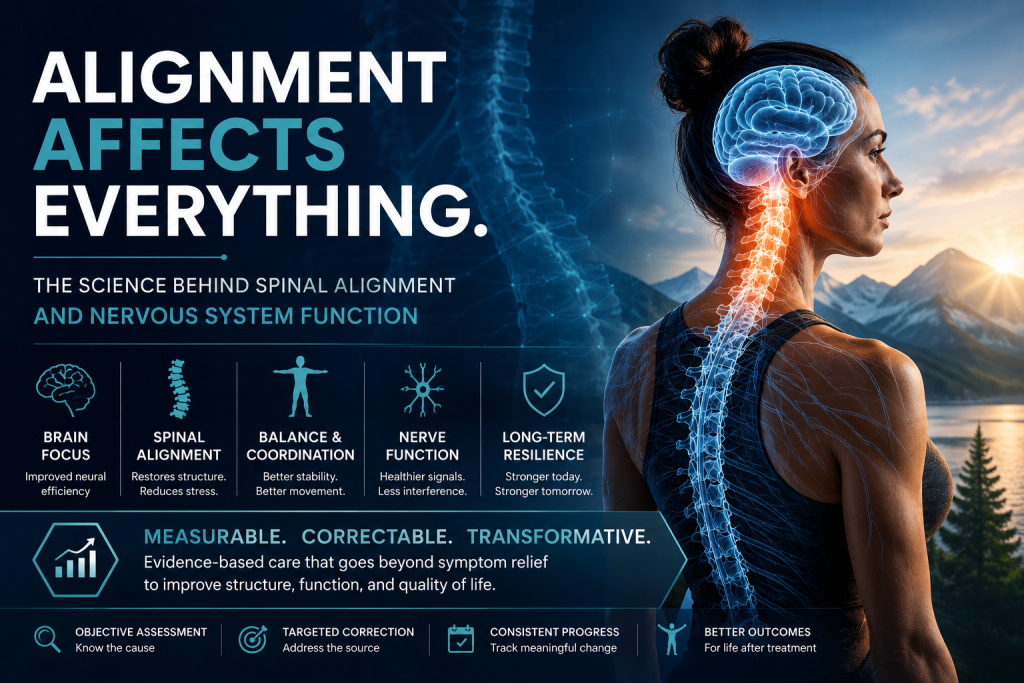
The Science Behind Spinal Alignment and Nervous System Function
Spinal alignment and nervous system function are closely connected. The spine provides the structural environment in which the spinal cord, nerve roots, muscles, joints, and sensory systems must function. When spinal alignment changes, the body does not simply ignore it—the nervous system must adapt.
For years, poor posture and altered spinal alignment were often discussed primarily as mechanical problems: increased muscle tension, abnormal joint loading, stiffness, and pain. Emerging research is adding another dimension. Altered spinal alignment and forward head posture have been associated with measurable changes in sensorimotor processing, balance control, nerve function, and brain-to-muscle communication.
That changes the conversation. Spinal alignment is not merely about how someone looks standing from the side. It may influence how efficiently the nervous system controls the body.
The Spine and Nervous System Work as One System
The brain and spinal cord form the central nervous system. But movement and balance require much more than signals traveling down the spinal cord. The brain continuously receives sensory information from muscles, joints, ligaments, vision, and the vestibular system. It integrates those signals and makes constant adjustments to maintain posture, coordinate movement, and keep the body balanced.
The normal curves of the spine help create an efficient mechanical environment for this process. They distribute gravitational loads, absorb forces, and position the head and trunk over the body’s center of mass.
When alignment changes, the nervous system must compensate for a different mechanical environment.
Forward head posture is a good example. As the head translates forward relative to the thorax, the muscles and joints responsible for controlling the head must function differently. The sensory information reaching the brain also changes because the position and loading of the cervical spine have changed.
The important question is no longer simply, “Does poor posture cause neck pain?”
A more interesting question is: How much additional work does the nervous system perform to compensate for abnormal posture?
New Research Is Beginning to Answer That Question
A 2025 study published in Scientific Reports examined corticomuscular coherence (CMC) in young adults with and without forward head posture. CMC evaluates synchronization between cortical activity measured by EEG and muscular activity measured by EMG during motor tasks.
Researchers studied 64 participants while progressively increasing the difficulty of balance tasks.
The participants with forward head posture demonstrated significantly different corticomuscular coherence across the measured frequency bands. Importantly, the groups could demonstrate similar outward balance performance while using different neurophysiological strategies to accomplish the task.
That distinction matters.
Two people may appear equally stable, yet one nervous system may require greater compensatory activity to produce that stability.
The study does not prove that forward head posture causes brain fatigue, cognitive impairment, or neurological disease. Those claims would exceed the evidence. What it does provide is evidence that forward head posture is associated with altered brain-muscle coordination during balance tasks.
That makes posture more than a cosmetic observation.
Other Research Points in the Same Direction
The 2025 findings do not stand alone.
Previous research has reported associations between forward head posture and changes in neurophysiological measures, balance, gait, physical performance, and sensorimotor control. [1] In one study of asymptomatic young adults, forward head posture was associated with significant differences in somatosensory evoked potentials and central conduction measures across multiple neural regions. Randomized trials investigating structural rehabilitation have also reported changes extending beyond pain.
For example, a randomized controlled trial involving patients with chronic cervical spondylotic radiculopathy compared conventional rehabilitation with the same rehabilitation plus cervical extension traction intended to restore cervical lordosis. Both groups initially improved, but the structural-rehabilitation group demonstrated sustained improvement in cervical alignment, pain, and dermatomal somatosensory evoked potentials at long-term follow-up. [2]
That is particularly important because it moves the discussion beyond subjective pain reporting and into measurable neurological function.
Another randomized controlled trial followed 72 patients with chronic cervicogenic dizziness. Both groups received multimodal rehabilitation, but one group also received cervical extension traction designed to improve cervical lordosis and forward head posture.
Both groups initially improved.
At the one-year follow-up, however, their trajectories were substantially different. The group receiving structural cervical rehabilitation maintained improved alignment and demonstrated better long-term outcomes in dizziness, pain, disability, and cervicocephalic kinesthetic measures. The conventional-treatment group showed regression toward baseline in several outcomes.
The implication is not that every patient with dizziness needs cervical traction. It is more specific: in appropriately selected patients with abnormal cervical sagittal alignment and cervicogenic dizziness, structural correction may be an important component of rehabilitation.
Why Alignment Can Influence Balance and Coordination
The cervical spine contains a dense network of mechanoreceptors that continually provide information about head and neck position.
The brain combines this cervical proprioceptive information with signals from the eyes and vestibular system to determine where the head and body are in space.
When cervical mechanics change, those inputs may also change.
This helps explain why researchers studying spinal alignment increasingly measure outcomes such as:
- head-repositioning accuracy,
- postural stability,
- gait,
- somatosensory evoked potentials,
- balance performance, and
- corticomuscular coherence.
These measurements investigate something pain scores alone cannot tell us: how the nervous system is controlling the body.
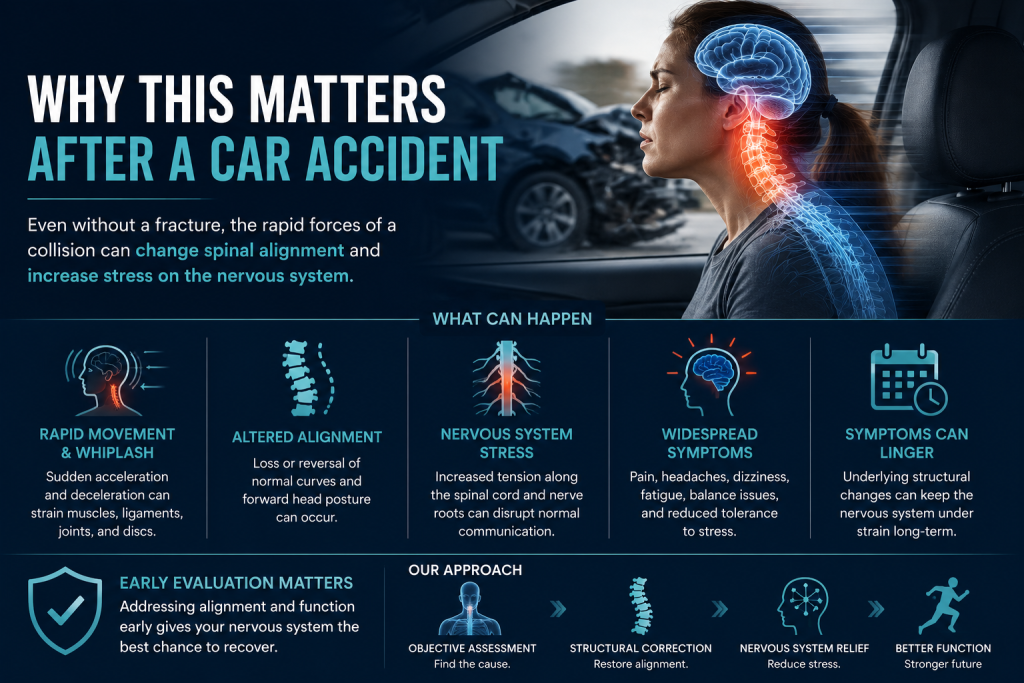
Why Spinal Alignment and Nervous System Function Matters After a Car Accident
This relationship becomes especially important after a motor vehicle collision.
Whiplash is a rapid biomechanical event. The cervical spine may undergo complex acceleration, extension, flexion, translation, and shear forces within fractions of a second. The resulting injury may involve muscles, discs, facet joints, ligaments, and other cervical structures even when there is no fracture.
Following trauma, some patients develop altered cervical alignment, forward head translation, loss or reversal of cervical lordosis, restricted movement, or compensatory posture.
The mistake is assuming that these findings matter only because they may hurt.
A better clinical question is whether the trauma has changed the mechanical and sensorimotor environment in which the nervous system must operate.
That requires measurement.
You Cannot Correct What You Have Not Measured
Symptoms are important, but symptoms alone cannot define spinal biomechanics.
At Elevation Health, structural evaluation can include digital radiography and computerized biomechanical analysis to measure cervical curvature, head translation, segmental relationships, and other postural deviations.
Those measurements allow us to ask more useful questions:
How far has the patient’s structure deviated from expected alignment?
Is the abnormality clinically meaningful?
Does it correlate with the examination, symptoms, function, and mechanism of injury?
And does it change with treatment?
This is an important distinction. An abnormal X-ray does not automatically prove that a patient’s symptoms came from that abnormality. Structural findings must be interpreted alongside the history, examination, neurological findings, functional testing, and other diagnostic evidence.
Objective measurement gives us one more piece of that clinical puzzle.
Why Chiropractic BioPhysics® Focuses on Structural Correction
Traditional conservative care frequently focuses on decreasing pain and restoring mobility. Those are worthwhile goals, but they are not necessarily the same as changing spinal structure.
Chiropractic BioPhysics® (CBP) uses a different model. Treatment may combine spinal manipulation or mobilization, corrective exercises, and sustained spinal traction selected according to the patient’s measured structural displacement.
Traction is particularly important because sustained loading can be used to influence spinal alignment over time.
Research involving cervical and thoracic structural rehabilitation has reported improvements in alignment accompanied by improvements in pain, disability, balance-related measures, sensorimotor function, and certain neurophysiological outcomes in specific patient populations.
This does not mean every postural abnormality requires correction, nor does it mean changing spinal alignment will cure every symptom.
It means that when a clinically significant structural abnormality is present, ignoring it may leave an important component of the patient’s problem untreated.
Feeling Better and Recovering Are Not Always the Same Thing
This may be the most important lesson from the research.
Pain can improve before the underlying biomechanics have meaningfully changed.
A patient may feel better after several weeks of treatment because muscle spasm has decreased, inflammation has subsided, and movement has improved. But if a significant structural abnormality remains, the mechanical environment that contributed to the problem may also remain.
Several structural-rehabilitation trials illustrate this distinction: comparison groups receiving conventional treatment often experienced short-term improvement, while groups receiving interventions that also changed spinal alignment demonstrated more durable outcomes at later follow-up. [3]
In a randomized trial of older adults with forward head posture and chronic neck pain, both groups initially improved, but the group receiving structural correction showed measurable improvement in craniovertebral angle and better maintained pain, balance, and head-repositioning outcomes at follow-up.
That does not prove that alignment explains every recurrence. It does suggest something clinically important:
Symptom reduction and structural rehabilitation should not automatically be considered the same endpoint.
References:
- Moustafa IM, Diab AAM, Harrison DE. Does Forward Head Posture Influence Somatosensory Evoked Potentials and Somatosensory Processing in Asymptomatic Young Adults? Journal of Clinical Medicine. 2023;12:3217. doi:10.3390/jcm12093217. This citation expains altered sensory processing and sensorimotor integration.
- Moustafa IM, Diab AA, Harrison DE. The Efficacy of Cervical Lordosis Rehabilitation for Nerve Root Function and Pain in Cervical Spondylotic Radiculopathy: A Randomized Trial with 2-Year Follow-Up. Journal of Clinical Medicine. 2022;11:6515. doi:10.3390/jcm11216515. This links cervical structural correction, DSSEP nerve-root function, pain, and two-year follow-up in a randomized trial. The structural-rehabilitation group improved and maintained cervical lordosis, while the study also measured corresponding changes in nerve-root function and pain.
- Al Suwaidi AS, Moustafa IM, Kim M, Oakley PA, Harrison DE. A Comparison of Two Forward Head Posture Corrective Approaches in Elderly with Chronic Non-Specific Neck Pain: A Randomized Controlled Study. Journal of Clinical Medicine. 2023;12:542. doi:10.3390/jcm12020542. This article discusses why feeling better and structural recovery are not necessarily the same thing. The study compared CBP-oriented correction with standardized exercise and measured CVA, pain, balance, head-repositioning accuracy, and cervical ROM