
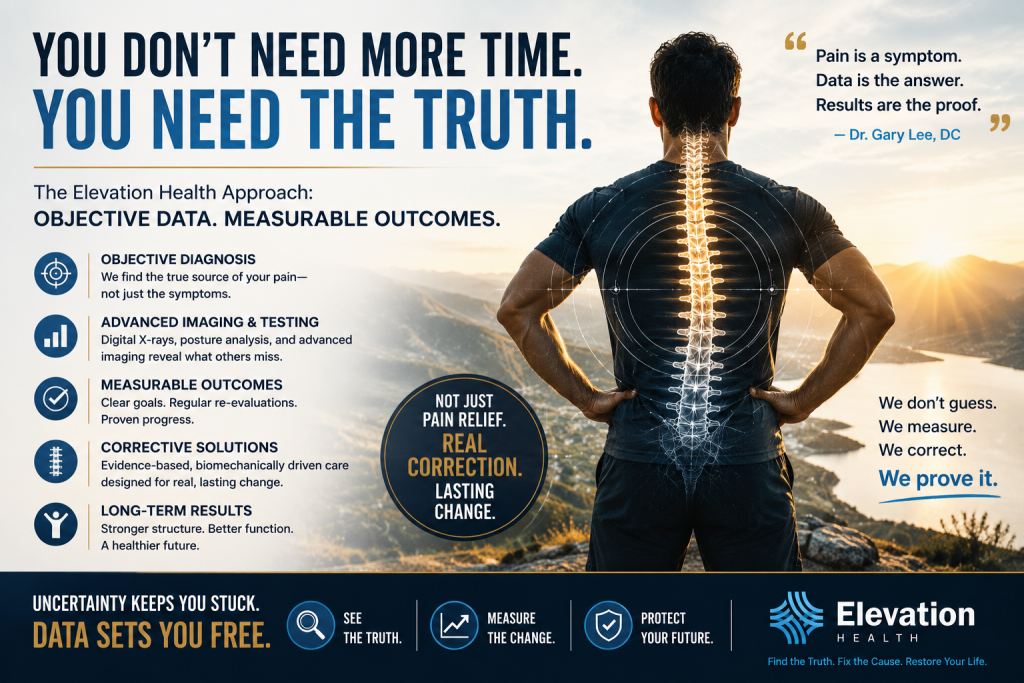
The Elevation Health Approach: Objective Data, Measurable Outcomes
When it comes to spine and injury care—especially for patients who have been injured in a car accident—one of the biggest frustrations is uncertainty. Patients are often told they should feel better, that healing “takes time,” or that pain levels are subjective. Evidence-Based Chiropractic Care begins with objective data, not guesswork. At Elevation Health, we use measurable findings to understand how the spine is functioning and to guide treatment decisions based on each patient’s needs.
This philosophy allows treatment decisions to be precise, progress to be verified, and long-term results to be protected.
Why Subjective Care Falls Short
Pain is real, but it is also variable. Stress, sleep, activity level, and even emotions can influence how pain is perceived on any given day. When care is based solely on symptoms:
- Progress becomes difficult to measure
- Treatment plans may drift without clear goals
- Patients may plateau without understanding why
This is especially problematic after car accidents, where structural injuries may persist even as pain fluctuates.
Elevation Health was built to remove this uncertainty by focusing on what can be measured.
Objective Data Creates Clarity
Objective chiropractic assessment provides a factual picture of spinal health. Rather than relying only on how a patient feels, Elevation Health evaluates how the spine is functioning mechanically and structurally.
This includes assessing:
- Posture relative to gravity
- Spinal curve integrity
- Segmental alignment
- Functional movement patterns
These findings help identify whether the spine is under abnormal stress—and why symptoms exist in the first place. This is a core principle of Evidence-Based Chiropractic Care: measure the problem first, then use those findings to guide the treatment plan.
Published research has evaluated quantitative methods for measuring cervical spinal alignment on radiographs, allowing structural changes to be tracked rather than estimated. [1]
The Role of Advanced Imaging
Imaging is used thoughtfully and strategically. Digital X-rays establish a structural baseline, allowing clinicians to measure spinal alignment and posture accurately. When indicated—especially after trauma—advanced imaging such as MRI or specialized studies may be recommended to evaluate soft tissue injury or instability.
This layered approach ensures that:
- Structural injuries are not overlooked
- Care is matched to the actual condition of the spine
- Treatment strategies remain appropriate as recovery progresses
For patients injured in car accidents, this clarity is critical to avoiding incomplete or misdirected care.
Measurable Goals, Not Open-Ended Treatment
One of the defining features of the Elevation Health approach is the use of clear, measurable treatment goals. Rather than vague timelines, care plans are designed around specific structural and functional targets.
Examples include:
- Improving spinal curve measurements
- Reducing abnormal head or torso translation
- Enhancing postural balance and endurance
Progress is reassessed periodically. If improvement is occurring, it is documented. If progress stalls, the plan is adjusted.
This accountability protects patients from unnecessary care while ensuring that meaningful correction is pursued.

Why Measurement Matters After a Car Accident
Car accidents often create subtle but significant Measurable Goals, Not Open-Ended Treatment
One of the defining features of the Elevation Health approach is the use of clear, measurable treatment goals. Rather than vague timelines, care plans are designed around specific structural and functional targets.
Examples include:
- Improving spinal curve measurements
- Reducing abnormal head or torso translation
- Enhancing postural balance and endurance
Progress is reassessed periodically. If improvement is occurring, it is documented. If progress stalls, the plan is adjusted.
Objective measurements are especially important after trauma because a car accident can alter spinal alignment and stability even when symptoms begin to improve.
This accountability protects patients from unnecessary care while ensuring that meaningful correction is pursued.
hanges in spinal mechanics. Even when pain improves, alignment and stability may remain compromised.
Without objective reassessment:
- Structural injuries may persist silently
- Degeneration risk may increase
- Symptoms may return months or years later
By tracking measurable outcomes, Elevation Health ensures that recovery is not assumed—it is verified.
Research following patients before and after rear-end collisions has documented measurable changes in cervical alignment, demonstrating why post-accident reassessment can provide information that symptoms alone cannot. [3]
Corrective Care Requires Proof of Change
Evidence-Based Chiropractic Care requires more than symptom improvement—it requires objective proof that meaningful change is occurring. Measurable chiropractic outcomes matter when improvements can be demonstrated.
Follow-up evaluations may include:
- Repeat posture analysis
- Follow-up imaging when clinically appropriate
- Functional reassessment
This allows both the clinician and the patient to see whether the spine is adapting toward healthier alignment—or whether additional intervention is needed.
A systematic review of controlled trials found that cervical extension traction can produce measurable changes in cervical lordosis, supporting the use of objective reassessment during corrective care. [2]
Educated Patients Heal Better
A key component of measurable evidence based chiropractic care is patient education. When patients understand:
- What their measurements mean
- How alignment affects stress and pain
- Why specific therapies are used
They become active participants in their recovery. This leads to better compliance, better outcomes, and greater confidence in the care process.
The Elevation Health Standard
Evidence-Based Chiropractic Care at Elevation Health is guided by objective measurements, biomechanics, and transparency. The goal is not simply to reduce pain, but to improve the structural foundation that supports long-term health.
This approach is particularly valuable for:
- Patients injured in motor vehicle collisions
- Individuals with chronic or recurring pain
- Those who want correction, not endless maintenance
- Patients concerned about future degeneration
Long-Term Outcomes Depend on Structure
The spine adapts to how it is loaded every day. If alignment remains poor, degeneration and pain often follow. If alignment improves, the spine becomes more resilient and efficient.
Objective data allows Elevation Health to influence this trajectory intentionally—reducing guesswork and increasing predictability.
Raising the Bar in Chiropractic Care
Healthcare should not rely on hope alone. It should be measurable, transparent, and accountable.
By combining objective data with corrective care principles, Elevation Health delivers a higher standard of chiropractic care—one focused on proven progress, real correction, and long-term results.
References
- Harrison DE, Harrison DD, Cailliet R, et al. “Cobb method or Harrison posterior tangent method: which to choose for lateral cervical radiographic analysis.” Spine. 2000;25:2072–2078
- Oakley PA, Ehsani NN, Moustafa IM, et al. “Restoring cervical lordosis by cervical extension traction methods in the treatment of cervical spine disorders: a systematic review of controlled trials.” Journal of Physical Therapy Science. 2021;33:784–794.
- Oakley PA, et al. “Positive Outcomes Following Cervical Extension Traction in Patients With Cervical Hypolordosis After Rear-End Motor Vehicle Collisions.” Journal of Clinical Medicine. 2023;12:6414.