
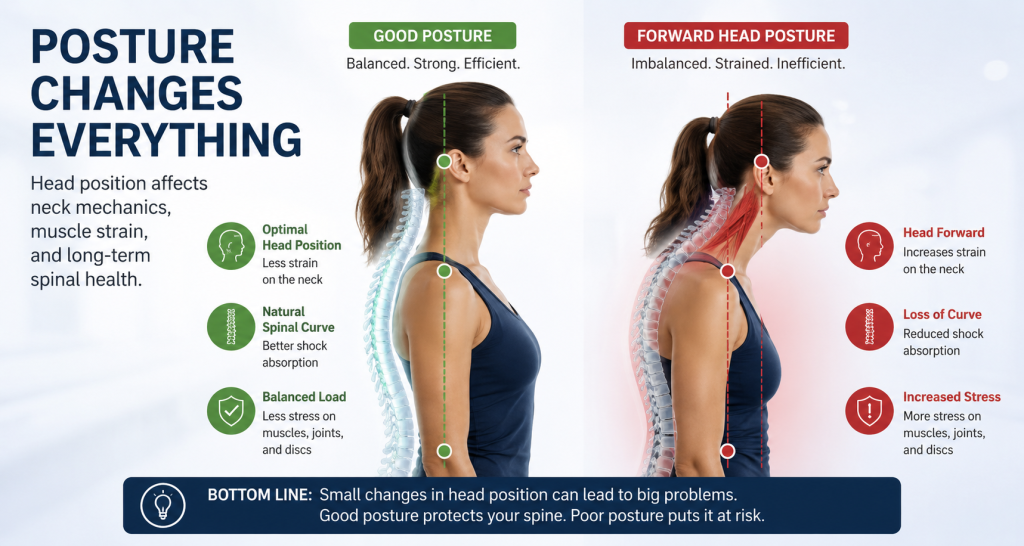
Poor posture and chronic pain are often connected, but posture is still frequently treated as a cosmetic problem—something that changes how a person looks but has little to do with how the body functions. From a biomechanical perspective, however, posture influences how gravity and everyday forces are distributed through the spine.
When the head, rib cage, pelvis, and spinal curves move away from more balanced alignment, the mechanical demands placed on muscles, joints, discs, and other supporting tissues can change. That does not mean every postural abnormality causes pain. Many people have measurable postural changes without significant symptoms. But in the right clinical context—particularly following a car accident—altered posture may become an important part of understanding persistent neck pain, headaches, muscle fatigue, restricted movement, and reduced physical tolerance.
At Elevation Health, the question is not simply, “Does your posture look abnormal?”
The more useful questions are: What changed? Can we measure it? Does it correlate with the patient’s symptoms and functional findings? And can we objectively determine whether it improves?
That is where Chiropractic Biophysics® (CBP®) and objective spinal analysis become particularly useful.
What Poor Posture and Chronic Pain Really Means
Posture describes the relationship of the body to gravity. In an efficiently aligned spine, the head, torso, pelvis, and spinal curves work together to distribute mechanical loads while allowing movement.
Poor posture [2] is more than simply “slouching.”
Postural changes may include forward head translation, altered cervical curvature, rounded or translated shoulders, increased or decreased thoracic curvature, pelvic displacement, or changes in lumbar lordosis.
Some of these changes develop gradually from prolonged sitting, repetitive activities, work demands, device use, deconditioning, or habitual positioning. Others may become clinically important after trauma.
This distinction matters.
A person who has gradually developed forward head posture over many years is not necessarily experiencing the same biomechanical problem as someone whose cervical alignment changed following a motor vehicle collision. Posture must be interpreted in the context of the patient, the mechanism of injury, symptoms, examination findings, imaging, and function.
How Poor Posture Can Contribute to Chronic Pain
The human body continually adapts to keep the eyes level and maintain balance.
When one region moves away from its preferred alignment, other regions may compensate. Muscles may work differently. Joint loading may change. Some tissues may remain under increased mechanical demand for prolonged periods.
Initially, the body may tolerate these changes remarkably well.
The problem develops when the mechanical demand exceeds the capacity of the tissues to adapt.
A patient may begin noticing neck or shoulder fatigue after working at a computer. Another may develop headaches after prolonged sitting. Someone recovering from a car accident may tolerate activity for an hour but experience increasing neck pain as the day progresses.
These patterns can be clinically important because pain is not the only measurement of recovery.
Endurance, range of motion, strength, activity tolerance, pain thresholds, and the ability to perform normal daily activities also help tell the story.
Posture becomes especially relevant when measurable structural abnormalities correlate with these functional limitations.
Forward Head Posture and Neck Pain
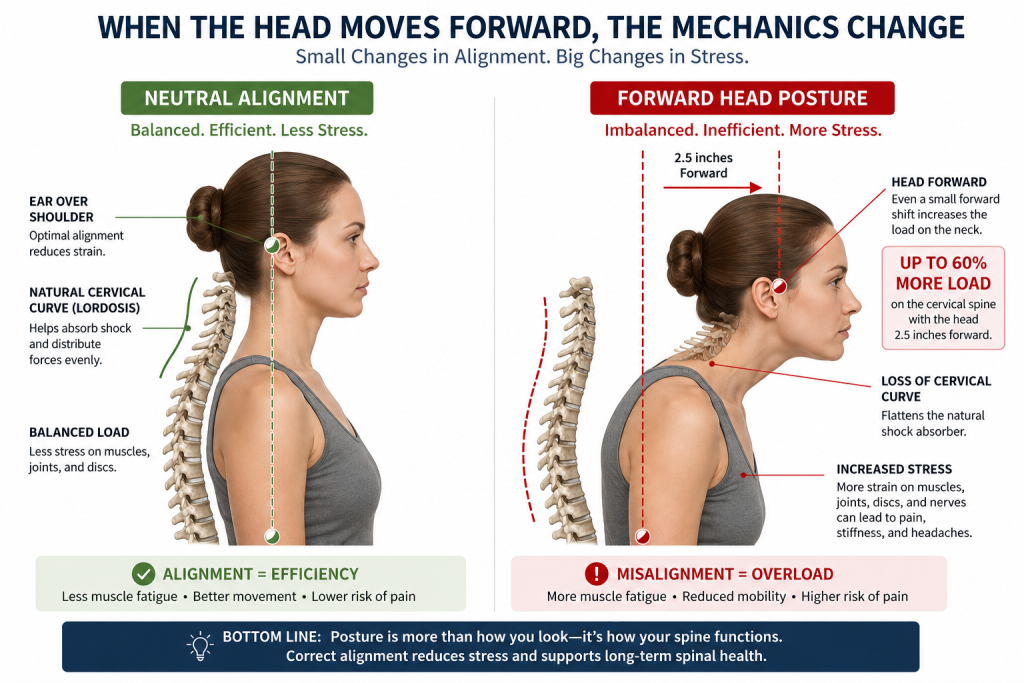
Forward head posture is one of the most recognizable postural abnormalities.
Viewed from the side, the head translates forward relative to the shoulders and thorax. The cervical spine and surrounding musculature must then adapt to maintain the head and keep the eyes level.
As the head translates forward, the mechanical demands placed on the cervical spine and supporting musculature change. This altered loading may increase muscular demand, affect cervical joint mechanics, and contribute to pain and functional limitations in susceptible patients.
But there is another important issue: forward head posture should not be evaluated in isolation.
The underlying cervical curve matters.
A patient may demonstrate forward head translation together with a loss of normal cervical lordosis, a straightened cervical spine, or even cervical kyphosis. Those findings represent different biomechanical relationships and may require different corrective strategies.
That is why simply looking at someone from across the room and telling them to “stand up straight” is not a structural assessment.
If the problem can be measured, the correction should be measured too.
Posture After a Car Accident Is Different
Motor vehicle collisions introduce another variable: trauma.
During a collision, rapid acceleration-deceleration forces can expose the cervical spine to complex loading before the muscles can adequately respond. Depending upon the collision and occupant dynamics, the resulting injury may involve muscles, discs, facet joints, ligaments, and other spinal structures.
The patient may initially be focused on pain, stiffness, or headaches. As acute symptoms change, however, altered spinal mechanics may remain.
This creates an important clinical distinction.
Pain reduction and biomechanical recovery are not necessarily the same thing.
A patient can feel considerably better while still demonstrating abnormal posture, altered spinal curvature, restricted motion, weakness, or other measurable functional deficits.
Conversely, an abnormal postural measurement alone does not prove that a collision caused it.
Determining the significance of a postural finding requires correlation with the history, mechanism of injury, examination, imaging, previous records when available, and the patient’s clinical course.
That is why objective documentation matters.
Why Stretching and Adjustments Alone May Not Correct Poor Posture and Chronic Pain
Stretching can be helpful. Exercise can be helpful. Chiropractic adjustments can be helpful.
But symptom relief should not automatically be confused with structural correction.
A patient may leave treatment moving better and feeling less pain. That is clinically valuable. But if the treatment goal includes changing a measurable postural or spinal alignment abnormality, we should be able to determine whether that change actually occurred.
This is where corrective care differs from treatment directed primarily toward temporary symptom reduction.
Long-standing postural adaptations involve more than one tight muscle. The neuromuscular system, spinal joints, connective tissues, habitual movement patterns, and spinal geometry interact with one another.
Meaningful correction may therefore require a combination of interventions rather than a single treatment.
The appropriate approach depends upon what was actually measured.
How Chiropractic Biophysics Measures Postural Changes
Chiropractic Biophysics is a system of spinal rehabilitation that emphasizes objective measurement, biomechanical analysis, and corrective strategies directed toward spinal alignment and posture.
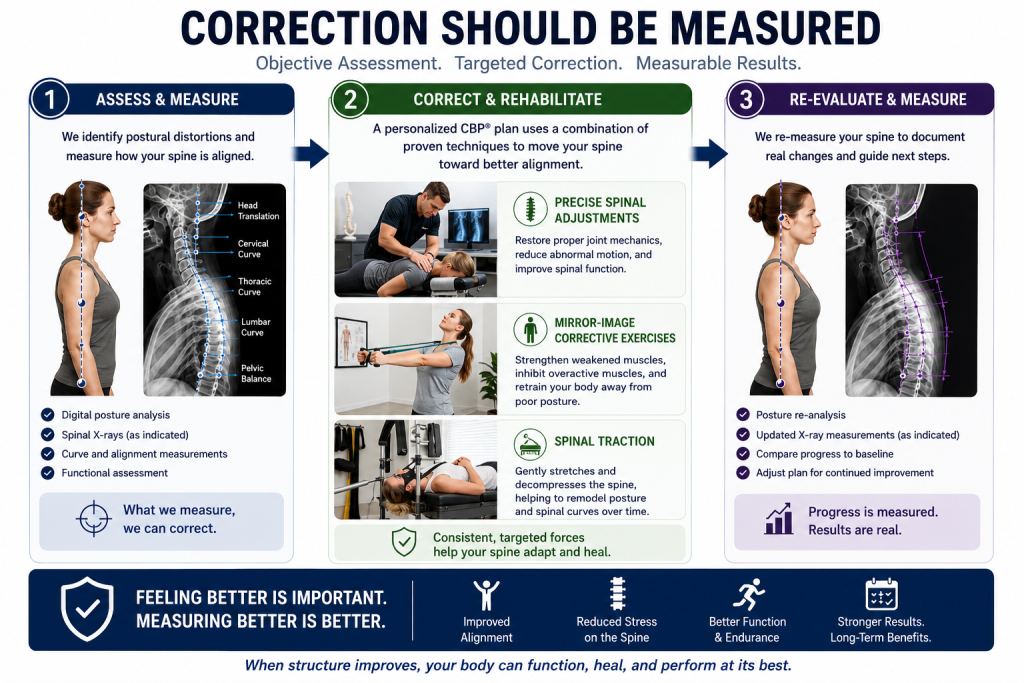
The evaluation may include postural analysis and, when clinically indicated, radiographic measurements of spinal alignment.
These measurements allow the clinician to evaluate relationships such as head translation, spinal curvature, segmental alignment, and other biomechanical parameters rather than relying exclusively on visual observation or symptoms.
That distinction is important.
If a patient says, “My neck feels better,” we have useful subjective information.
If objective reassessment also demonstrates improved posture, spinal alignment, range of motion, strength, or functional capacity, we have additional evidence about what changed.
The goal is not to replace the patient’s experience with measurements. It is to combine the two.
How CBP Posture Correction Works
CBP-based corrective care [1] may incorporate spinal adjustments, corrective exercises, and specialized traction depending upon the patient’s findings and clinical indications.
One of the distinguishing components is the use of corrective forces designed around the patient’s measured postural or spinal displacement.
Mirror-image exercises, for example, are intended to train movement away from the measured postural displacement. Corrective traction can apply sustained forces intended to influence spinal alignment over time.
This is different from simply stretching the area that hurts.
The treatment is directed toward a measured biomechanical problem, and periodic re-evaluation allows the clinician to determine whether the intended change is actually occurring.
Not every patient requires the same procedures, treatment frequency, or duration. The plan should be based on the patient’s examination, imaging when appropriate, tolerance, response to care, and measurable progress.
Feeling Better Is Important. Measuring Better Is Better.
One of the problems in musculoskeletal care is the assumption that less pain automatically means the underlying problem has resolved.
Pain matters enormously. It is one of the primary reasons patients seek treatment.
But it is only one outcome.
Consider a patient who reports that neck pain has decreased from an eight to a three. That is meaningful improvement.
Now suppose the same patient still demonstrates substantially restricted cervical range of motion, reduced strength, abnormal posture, decreased activity tolerance, or pain with ordinary work and household activities.
Has the patient recovered?
Not necessarily.
This is why objective functional testing and structural reassessment can be so valuable, particularly following traumatic injury.
Recovery should increasingly be demonstrated rather than assumed.
Posture Correction After a Car Accident
For patients injured in motor vehicle collisions, the first priority is not to force the spine into an idealized posture.
The first priority is to understand what was injured and what is mechanically appropriate for that patient.
This is particularly important when ligament injury or spinal instability is suspected. An unstable spinal segment presents a fundamentally different problem from a stable spine with a correctable postural displacement.
That distinction can change the treatment strategy.
When appropriate, evaluation may therefore extend beyond ordinary postural measurements to include additional imaging or functional assessment.
Once the patient’s condition is sufficiently understood, corrective rehabilitation can be directed toward improving the mechanical deficits that are appropriate to address.
This is one reason accurate diagnosis should precede aggressive correction.
At Elevation Health, our auto accident care approach evaluates the structural and biomechanical effects of trauma rather than focusing on symptoms alone.
Why Objective Re-Evaluation Matters
A corrective treatment plan should contain a built-in question:
Did it work?
Not merely:
Does the patient hurt less?
Re-evaluation allows the clinician to compare findings over time. Depending upon the patient’s condition, this may include posture, spinal alignment, range of motion, strength, pain thresholds, functional capacity, and other clinically relevant measurements.
This transforms treatment from an open-ended process into a measurable progression.
If the patient is improving, the findings should help demonstrate that improvement.
If the patient is not progressing as expected, the clinician has objective information indicating that the treatment plan, diagnosis, or underlying assumptions may need to be reconsidered.
That is evidence-informed care.
The Elevation Health Approach to Posture Correction
At Elevation Health, posture is not treated as an isolated cosmetic finding.
For patients recovering from car accident injuries, postural and spinal alignment findings are considered alongside the mechanism of injury, symptoms, examination findings, functional deficits, imaging, and response to care.
When corrective care is appropriate, the objective is not simply to make the patient “stand straighter.”
The objective is to identify clinically meaningful biomechanical abnormalities, determine how they relate to the patient’s condition, and develop a treatment strategy that can be objectively reassessed.
That means asking better questions throughout the recovery process:
What are we treating?
Why are we treating it?
How are we measuring it?
And how will we know when it has improved?
Those questions are particularly important after a motor vehicle collision, when temporary symptom improvement can sometimes hide persistent functional or biomechanical deficits.
Why Posture Correction Matters Long Term
The spine is exposed to gravity and mechanical loading every day.
How those forces are distributed matters.
Abnormal spinal alignment can alter the mechanical environment experienced by joints, muscles, discs, and supporting tissues. Over time, persistent abnormal loading may contribute to reduced tolerance, recurring symptoms, or degenerative changes in susceptible individuals.
This does not mean that every postural abnormality will inevitably produce degeneration or chronic pain.
It means that when a measurable biomechanical abnormality corresponds with a patient’s symptoms and functional deficits, ignoring it simply because the patient temporarily feels better may leave part of the clinical problem unanswered.
Improving spinal alignment may also be important when considering how abnormal mechanical loading contributes to future spinal degeneration. The goal of corrective care should therefore extend beyond chasing symptoms.
It should be to create the best reasonable mechanical environment for long-term function.
Correcting the Mechanical Problem, Not Just the Symptoms
Chronic neck and back pain are rarely explained by one measurement, one X-ray, or one postural finding.
The body is more complicated than that.
But posture and spinal alignment can provide important pieces of the clinical picture—especially when they are measured objectively and interpreted alongside the patient’s history, examination, imaging, and functional findings.
Chiropractic Biophysics provides a framework for identifying these biomechanical abnormalities and, when appropriate, developing corrective strategies intended to change them.
For patients recovering after a car accident, this distinction can be particularly important.
The goal should not simply be to feel better today.
The larger goal is to understand what changed, identify what remains abnormal, correct what can reasonably be corrected, and objectively demonstrate meaningful recovery.[3]
Because when the problem can be measured, improvement should be measured too.
References
- Norton TC, Oakley PA, Haas JW, Harrison DE. (2023).
Positive Outcomes Following Cervical Acceleration-Deceleration (CAD) Injury Using Chiropractic BioPhysics® Methods… Journal of Clinical Medicine, 12, 6414. - McAviney J, Schulz D, Bock R, Harrison DE, Holland B. (2005). Determining the relationship between cervical lordosis and neck complaints
-
Moustafa IM, Diab AA, Hegazy F, Harrison DE. Does improvement towards a normal cervical sagittal configuration aid in the management of cervical myofascial pain syndrome: a 1-year randomized controlled trial. BMC Musculoskeletal Disorders. 2018;19:396.
Positive Outcomes Following Cervical Acceleration-Deceleration (CAD) Injury Using Chiropractic BioPhysics® Methods: A Case Series of Seven Patients. Journal of Clinical Medicine. 2023;12:6414.