
The Role of Digital X-Rays in Understanding Structural Spinal Problems
When someone is dealing with ongoing neck or back pain—especially after being injured in a car accident—one of the most common questions is: “Why does it still hurt?” The answer is often structural, and that’s where digital X-rays play a critical role.
Digital X-rays are not just diagnostic tools; in corrective chiropractic care, they are foundational. They allow doctors to move beyond symptoms and understand how the spine is actually functioning under load.
Pain Does Not Always Reveal the Problem
Pain is a warning signal, but it does not tell us what is wrong or why it developed. Two people may report identical symptoms while having completely different spinal issues. One may have muscular tension, while another has lost normal spinal curves or developed instability after trauma.
This is especially true after motor vehicle collisions. Car accidents can cause:
- Loss of normal cervical or lumbar curvature
- Forward head or torso translation
- Subtle joint misalignment
- Abnormal stress on discs and ligaments
Many of these changes are not detectable through physical examination alone. Digital X-rays provide the missing structural context.
What Makes Digital X-Rays Different?
Modern digital X-ray systems are faster, clearer, and use significantly lower radiation doses than older film-based technology. But the real value lies in how the images are analyzed.
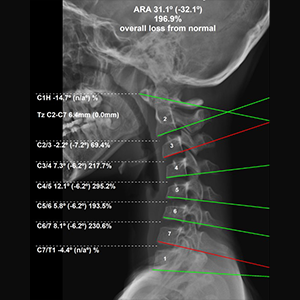
In a corrective-care setting, X-rays are not simply viewed—they are measured. Doctors assess:
- Spinal curvature angles
- Head and torso positioning
- Segmental alignment
- Weight-bearing stress patterns
These measurements are compared to well-established biomechanical models of normal spinal alignment. This transforms imaging from a “snapshot” into a functional blueprint of how the spine is coping with gravity and daily activity.
Why Imaging Matters After a Car Accident
After a car accident, patients are often told that their X-rays are “normal” because no fractures are present. While this is reassuring, it does not mean the spine is uninjured.
Whiplash and collision forces frequently cause alignment and soft-tissue injuries, not broken bones. Digital X-rays can reveal:
- Straightening or reversal of normal spinal curves
- Abnormal head positioning relative to the shoulders
- Stress concentrations at specific spinal levels
These findings help explain why pain persists weeks or months after an accident—even when initial treatments provided only temporary relief.
Structure-Based Care vs. Symptom-Based Care
Without imaging, care often focuses on where it hurts. With imaging, care focuses on why it hurts.
If a patient has lost cervical lordosis after a rear-end collision, treating muscle tension alone will not restore normal biomechanics. The spine remains under abnormal load, and symptoms are likely to return.
Digital X-rays allow care to be:
- Targeted to specific structural faults
- Customized to the patient’s unique alignment
- Monitored over time to confirm real change
This is a key distinction between traditional symptom-based chiropractic and corrective approaches such as Chiropractic Biophysics® (CBP).
Tracking Progress, Not Guessing
One of the most important—but often overlooked—benefits of digital X-rays is accountability. Corrective care should produce measurable change, and imaging allows that change to be verified.
Follow-up X-rays can demonstrate:
- Improvement in spinal curves
- Reduction in abnormal translations
- Better load distribution across joints
For patients recovering from car accidents, this confirmation is critical. It shows that care is not just reducing pain temporarily, but addressing the structural consequences of trauma.
Addressing Safety Concerns
A common concern among patients is radiation exposure. Modern digital X-ray systems use very low doses, and imaging is performed only when clinically necessary. In many cases, the benefit of identifying and correcting a structural problem far outweighs the minimal exposure involved.
When imaging is used responsibly, it becomes a tool for prevention—helping avoid chronic degeneration, repeated flare-ups, and unnecessary long-term care.
The Elevation Health Approach
At Elevation Health, digital X-rays are an integral part of understanding spinal health, particularly for patients injured in motor vehicle collisions.
Imaging is used to:
- Establish an accurate structural baseline
- Identify trauma-related alignment changes
- Design precise corrective care plans
- Re-evaluate progress objectively
Patients are shown and educated on their images, so they understand how posture and alignment affect their symptoms and long-term recovery.
Why This Matters for Long-Term Health
Spinal problems rarely improve on their own when structure is compromised. Left uncorrected, abnormal alignment increases wear on joints and discs, raising the risk of early arthritis and chronic pain.
Digital X-rays provide clarity. They replace assumptions with data and allow care to focus on correction rather than compensation—a distinction that is especially important after injury.
Seeing the Whole Picture
Understanding spinal health requires more than asking where it hurts. It requires seeing how the spine is positioned, how it handles load, and how trauma has altered its mechanics.
Digital X-rays make that possible—and in corrective chiropractic care, they are not optional. They are essential.