Why the Right Diagnosis Matters After an Auto Accident
An accurate diagnosis after an auto accident is the first step toward understanding the injury and choosing the right treatment.
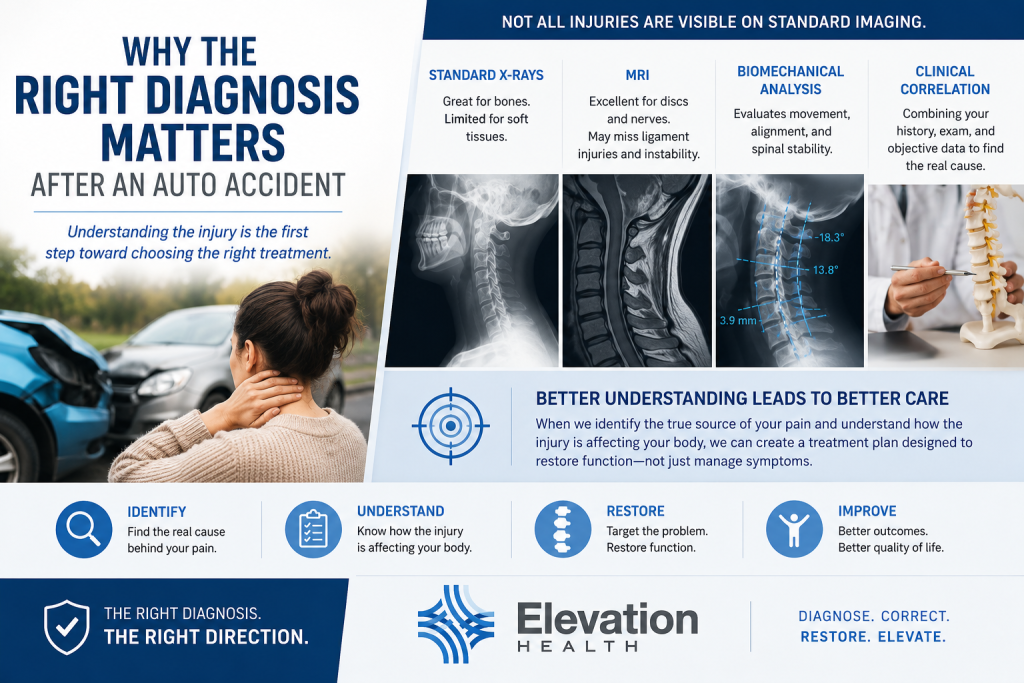
Motor vehicle collisions can produce injuries that range from mild muscle strains to complex ligament and spinal injuries. While many patients recover within weeks, others continue to experience persistent pain despite receiving appropriate initial care. Understanding why this happens begins with understanding the importance of an accurate diagnosis.
Every Injury Has a Story
Every year, thousands of people are involved in motor vehicle collisions and leave the emergency department relieved to hear that nothing appears to be broken. Standard X-rays may be normal, advanced imaging may reveal only minor findings, and many patients are told they simply have “whiplash” that should resolve within a few weeks.
For many people, recovery is straightforward. However, research consistently shows that recovery is not the same for everyone. Approximately half of individuals who sustain whiplash-associated disorders continue to experience ongoing pain and disability, and some continue to report reduced physical quality of life even five years after their injury.¹ ²
When symptoms persist, the most important question isn’t simply:
“What treatment should I receive?”
It’s:
“Has the underlying injury been accurately identified?”
Because treatment can only be as effective as the diagnosis that guides it.
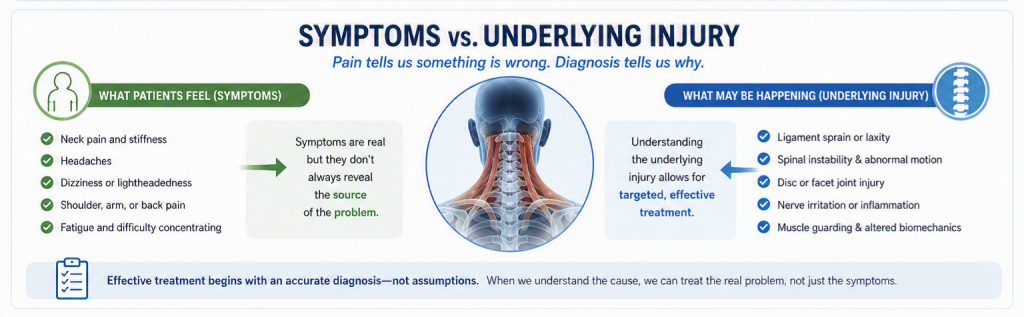
Not Every Injury Is Visible on Standard Imaging
Modern imaging is one of the greatest advances in medicine. X-rays, CT scans, and MRI each provide valuable information, but every imaging study has strengths and limitations.
Standard X-rays
Excellent for:
- Fractures
- Alignment
- Degenerative changes
Limited for:
- Ligament injuries
- Soft tissue damage
- Functional instability
MRI
Excellent for:
- Disc injuries
- Nerve compression
- Soft tissue evaluation
May not always demonstrate:
- Ligament laxity
- Abnormal spinal motion
- Mechanical instability
When symptoms persist or examination findings warrant further investigation, understanding when an MRI is needed after a crash can help guide the diagnostic process.
Why Clinical Evaluation Matters
Imaging should never replace a thorough history and physical examination.
Objective clinical findings, patient history, biomechanical assessment, and imaging work together to develop a more complete understanding of an injury.
No single test tells the whole story.
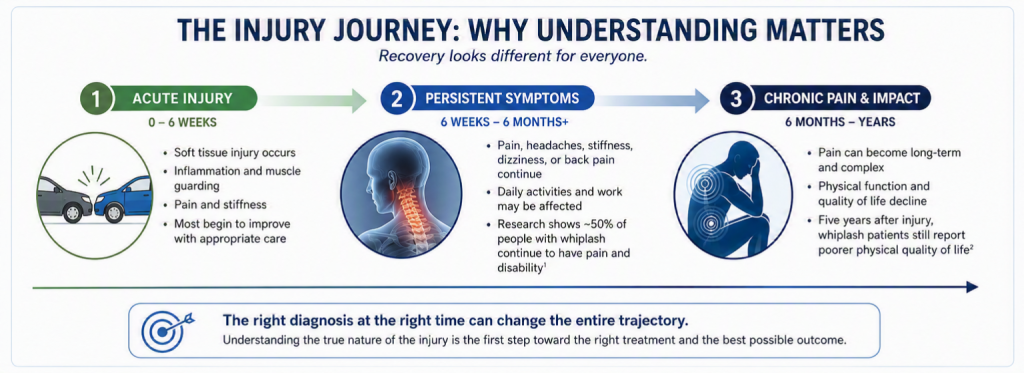
Symptoms Tell Us Something Is Wrong—But They Don't Tell Us Why
Pain is the body’s alarm system.
It tells us that something deserves attention, but it rarely identifies the exact structure responsible.
Two patients may both complain of neck pain after an accident.
One may have a simple muscular strain that resolves within weeks.
The other may have ligament injury resulting in altered spinal mechanics that continues to generate pain months—or years—later.
Although their symptoms appear similar, the underlying injuries may be very different.
Terms such as sprain and strain after a car accident may describe an injury without fully identifying the structures involved.
Some collision injuries can result in spinal instability after an auto accident, particularly when supporting ligaments have been damaged.
A thorough diagnosis after an auto accident should combine the patient’s history, clinical examination, imaging when appropriate, and objective biomechanical findings.
The Elevation Health Approach
The purpose of diagnosis is not simply to assign a label.
It is to understand:
- What structures were injured
- How those injuries affect movement
- Why symptoms continue
- Which treatment options are most appropriate
A more accurate understanding of the injury allows healthcare providers to develop treatment strategies directed toward restoring function—not simply reducing pain.
Key Takeaways
At Elevation Health, we believe every patient deserves a comprehensive evaluation. Our approach combines multiple sources of clinical information to better understand the complete picture of an injury.
Key Components
- Clinical History – Understanding how the injury occurred and how symptoms have progressed.
- Physical Examination – Evaluating movement, strength, neurological function, and areas of pain.
- Standard Imaging – Reviewing X-rays and MRI findings when available.
- Advanced Imaging – Utilizing additional imaging when clinically indicated.
- Objective Biomechanical Analysis – Assessing spinal movement and stability using objective measurements.
- Functional Assessment – Evaluating how the injury affects daily activities and overall function.
Rather than treating symptoms alone, our goal is to identify the underlying cause of dysfunction and develop individualized treatment plans based on objective clinical findings whenever possible.
What This Means for You
The right diagnosis creates the foundation for the right care. At Elevation Health, our approach combines a detailed clinical evaluation with objective imaging and biomechanical findings when appropriate to better understand how an auto accident has affected the spine.
If you are still experiencing symptoms after a collision or want a clearer understanding of your injury, learn more about our Auto Accident Care and how we approach diagnosis, correction, and recovery.
References
- Ritchie C, Ehrlich C, Sterling M. Living with ongoing whiplash associated disorders: A qualitative study of individual perceptions and experiences. BMC Musculoskeletal Disorders. 2017;18:531.
- Hours M, Khati I, Charnay P, et al. Five years after the accident, whiplash casualties still have poorer quality of life in the physical domain than other mildly injured casualties: Analysis of the ESPARR cohort. BMC Public Health. 2016;16:13.