Why "Sprain" and "Strain" Don't Tell the Whole Story
Sprain vs strain after a car accident can be useful diagnostic terms, but these broad labels may not tell the whole story about which tissues were actually injured in a motor vehicle collision.
Introduction
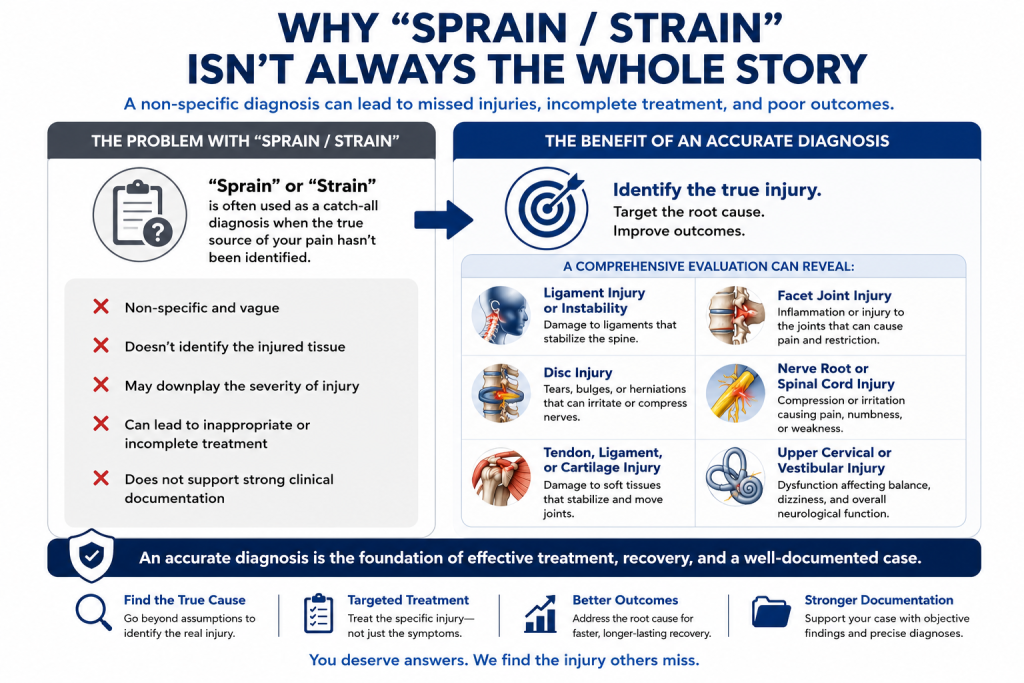
If you’ve been injured in a motor vehicle collision, you may have been told you have a sprain, strain, or whiplash. While these are legitimate medical diagnoses, they do not always provide a complete picture of what has actually been injured.
An accurate diagnosis should do more than describe where it hurts or identify the general type of tissue involved. It should identify the injured structures, communicate the nature and severity of the injury, and provide a foundation for evidence-based treatment and recovery.
Understanding the difference between a broad diagnosis and a more specific diagnosis is important—not only for making informed treatment decisions, but also for communicating medical necessity to insurance companies and providing clear, objective documentation when legal representation is involved. A broad diagnosis may be appropriate initially, but the right diagnosis after an auto accident can provide a clearer understanding of the injured structures and help guide appropriate treatment.
At Elevation Health, we believe that identifying what was injured is just as important as understanding how it happened. A comprehensive evaluation is designed to move beyond general diagnostic labels and identify the underlying injuries that guide appropriate patient care.
What is a Sprain or a Strain?
What Is a Sprain?
A sprain is an injury involving a ligament—the strong bands of connective tissue that connect bone to bone and help stabilize joints.
During a motor vehicle collision, the rapid acceleration and deceleration forces experienced by the body can stretch or damage these ligaments. Depending on the force of impact, ligament injuries may range from microscopic tearing to complete rupture and, in some cases, may contribute to joint instability.
The term sprain accurately describes the type of tissue that has been injured. However, by itself, it does not answer several important clinical questions:
- Which ligament has been injured?
- How severe is the injury?
- Is the joint stable or unstable?
- Are additional structures also involved?
- How should the injury be treated?
These questions require a comprehensive clinical evaluation and, when appropriate, additional diagnostic testing.
What Is a Strain?
A strain is an injury involving a muscle or tendon.
Muscles and tendons work together to produce movement and stabilize the spine and extremities. During a collision, these tissues may be injured as they rapidly contract in an attempt to protect the body from sudden forces.
Like a sprain, a strain is a legitimate medical diagnosis. However, it describes only the type of tissue involved—it does not identify the specific muscle or tendon, explain why symptoms persist, or determine whether additional injuries are present.
For example, persistent neck or shoulder pain following a collision may involve muscle injury, but it may also be associated with ligament damage, facet joint injury, nerve irritation, or other structures that require different treatment approaches.
A thorough evaluation helps distinguish among these possibilities so treatment can be directed toward the actual source of the patient’s symptoms.
Objective Evaluation and the Importance of Appropriate Imaging
An accurate diagnosis begins with a comprehensive clinical evaluation—not with a single imaging study. Ultimately, sprain vs strain after a car accident should be viewed as a starting point for diagnosis—not necessarily the complete explanation for persistent symptoms or functional problems.
Following a motor vehicle collision, the diagnostic process should integrate a detailed history of the collision, orthopedic and neurological examination, functional testing, and imaging studies when clinically indicated. Each component provides important information that helps identify the injured tissues, determine whether advanced imaging such as MRI is indicated following a crash, assess the nature and severity of the injuries, and guide the development of an evidence-based treatment plan.
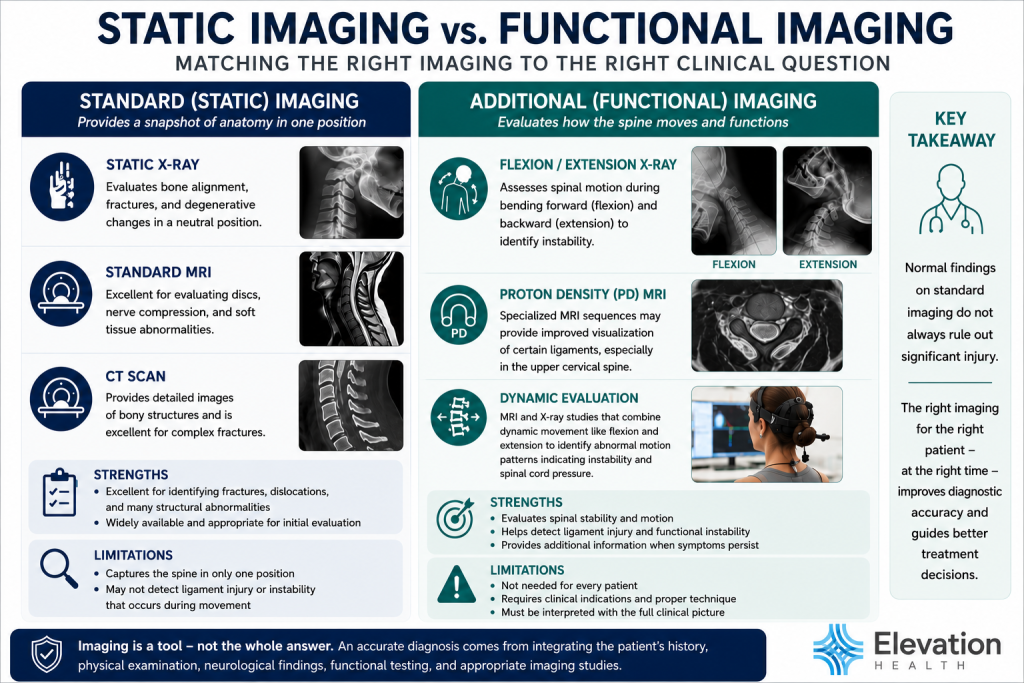
Standard imaging studies, including plain radiographs (X-rays), computed tomography (CT), and conventional magnetic resonance imaging (MRI), are essential tools for evaluating fractures, dislocations, degenerative changes, and many soft tissue injuries. However, these studies are typically performed with the patient in a neutral position and provide only a static view of the spine.
Ligament injuries present a unique diagnostic challenge because the ligaments themselves are often difficult to visualize on routine imaging. In addition, stretched or mechanically compromised ligaments may appear structurally intact while still allowing abnormal joint motion. As a result, clinically significant spinal instability after an auto accident may exist even when standard imaging appears unremarkable. Hauser and colleagues note that conventional MRI may identify complete ligament tears but is less effective at detecting ligament laxity or functional instability, emphasizing that imaging findings should always be interpreted together with a thorough clinical examination.
When clinical findings suggest ligamentous injury or spinal instability, additional imaging may be appropriate. Dynamic flexion-extension radiographs evaluate spinal motion during controlled movement and may reveal abnormal translation or angulation that cannot be appreciated on static films. Likewise, specialized MRI protocols—including proton density (PD) sequences when clinically indicated—may provide improved visualization of certain ligamentous structures, particularly within the upper cervical spine, compared with routine imaging protocols.
The importance of selecting the appropriate imaging study has long been recognized. White and colleagues observed:
“The reported frequency of missed injuries in the cervical spine varies from 4% to 30%. The most common reason cited for missed injuries is an inadequate radiographic examination… even in the absence of fractures, clinically significant instability can exist.”
For this reason, imaging should never be interpreted in isolation. A patient’s history, physical examination, neurological findings, functional assessment, and appropriately selected imaging studies all contribute to an accurate diagnosis. The objective is not simply to identify abnormalities on an image, but to understand which tissues have been injured, the severity of those injuries, and how they influence function, treatment decisions, and long-term recovery.
Why Diagnostic Specificity Matters
Understanding sprain vs strain after a car accident is important, but these broad diagnostic terms may not identify the specific tissues injured during the collision. A diagnosis is much more than a label—it communicates the nature, location, and often the severity of an injury.
There is an important difference between documenting neck pain, cervical sprain, cervical ligament injury, and cervical instability. Each diagnosis conveys different clinical information and may have different implications for evaluation, treatment, prognosis, and follow-up. When symptoms or examination findings suggest a more significant injury, understanding when an MRI is needed after a crash can help determine whether additional imaging is appropriate.
A precise diagnosis helps healthcare providers determine:
- Which tissues have been injured.
- Whether the injury appears stable or unstable.
- Whether additional testing or advanced imaging is clinically indicated.
- The most appropriate treatment strategy.
- How recovery should be monitored over time.
As more objective information becomes available during the evaluation, the diagnosis often becomes more specific. Refining a diagnosis is a normal part of evidence-based clinical care.
Clinical Insight
Pain is a symptom, not a diagnosis. Understanding which tissues have been injured allows treatment to focus on restoring function, not just relieving symptoms. A specific diagnosis does more than explain your pain—it identifies the injured tissues, guides appropriate treatment, and helps establish realistic expectations for recovery.
Key Takeaways-The Bottom Line
- Terms such as sprain, strain, and whiplash have legitimate medical definitions, but they are often only the beginning of the diagnostic process following an auto accident.
- The goal of a comprehensive evaluation is not simply to assign a diagnosis—it is to identify the injured tissues, understand the severity of the injury, and develop a treatment plan based on objective clinical findings.
- A more specific diagnosis improves clinical decision-making, guides evidence-based treatment, enhances communication among healthcare providers, and supports accurate documentation throughout recovery.
- At Elevation Health, we believe that understanding what was injured is the foundation for helping patients recover safely, effectively, and with confidence.
References
- White AA III, Johnson RM, Panjabi MM, Southwick WO. Biomechanical Analysis of Clinical Stability in the Cervical Spine. Clinical Orthopaedics and Related Research. 1975;109:85–96.
- Torretti JA, Sengupta DK. Cervical Spine Trauma. Indian Journal of Orthopaedics. 2007;41(4):255–267.
- Hauser RA, Dolan EE. Ligament Injury and Healing: A Review of Current Clinical Diagnostics and Therapeutics. Open Rehabilitation Journal. 2013;6:1–20.