
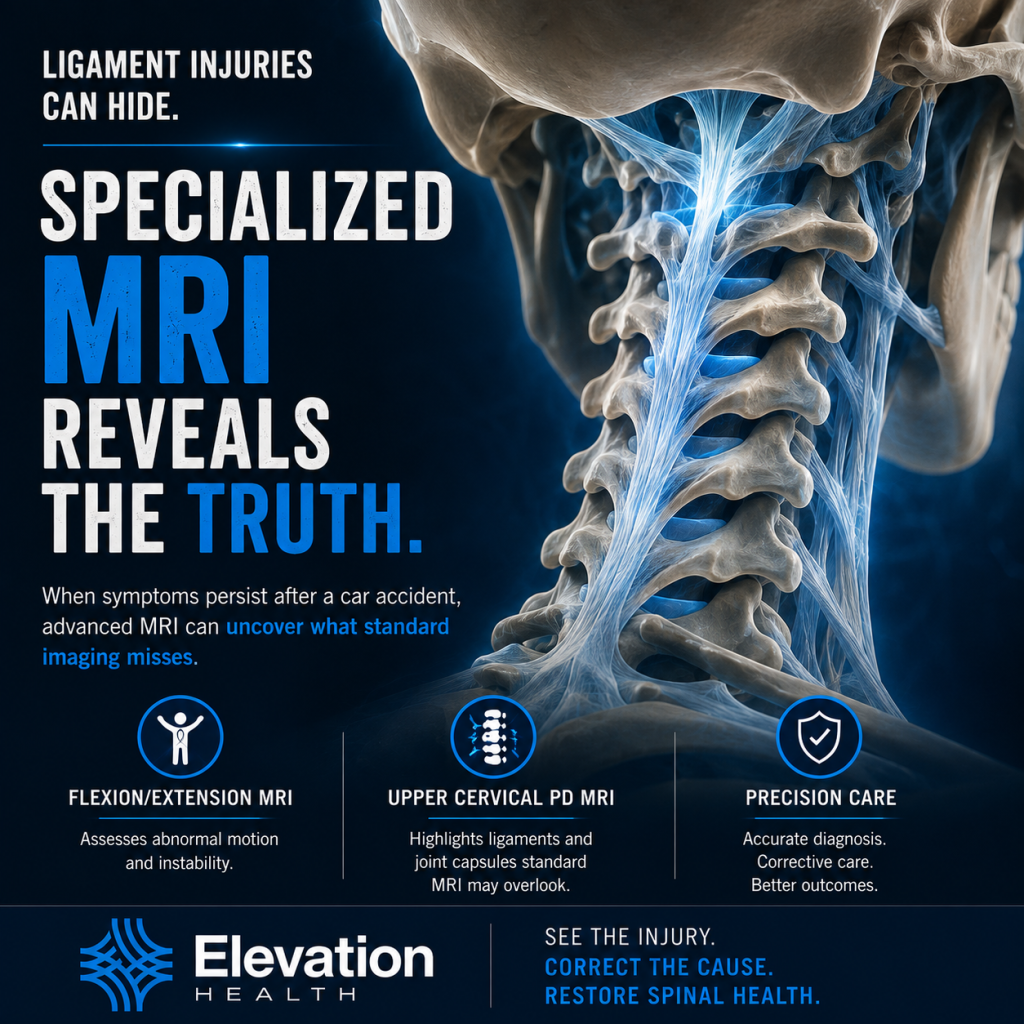
Understanding when an MRI is needed after a crash can be important when neck pain, headaches, dizziness, or instability persist after a motor vehicle collision.
Many patients are told that a “normal MRI” means nothing serious is wrong. Yet many continue to suffer from neck pain, headaches, dizziness, or a feeling that their neck simply doesn’t feel right after a car accident. The problem isn’t always that the injury doesn’t exist—it may be that the wrong imaging was performed.
At Elevation Health, we recognize that ligament injuries and spinal instability are often invisible on standard MRI studies. Specialized imaging can reveal injuries that conventional imaging may overlook, allowing treatment to target the true source of persistent symptoms.
Why Ligament Injuries Are Commonly Missed
Ligaments are the stabilizing structures of the spine. They limit excessive motion and protect joints, discs, and the nervous system. During a car accident, especially whiplash-type events, ligaments are often subjected to forces beyond their normal tolerance.
Unlike muscles, ligaments:
- Heal slowly
- Do not regenerate well
- Can remain permanently lax if injured
The challenge is that ligament injuries do not always appear clearly on standard MRI studies. Many conventional MRIs are performed with the patient lying flat, in a neutral position, and using sequences optimized for discs—not stability.
As a result, patients may be told their MRI is “normal” despite ongoing symptoms.
| Standard MRI | Specialized MRI |
|---|---|
| Excellent for discs | Better evaluates ligament injury |
| Static image | Evaluates instability |
| Neutral position | Assesses the spine under movement |
| Detects compression | Detects abnormal motion |
Why Standard MRI Has Limitations
Traditional MRI is excellent for identifying:
- Disc herniations
- Nerve compression
- Major structural abnormalities
However, it has limitations when evaluating functional instability and subtle ligament damage. This is because:
- The spine is imaged in a static position
- Abnormal motion is not assessed
- Certain ligaments are difficult to visualize without specific sequences
For patients with post-traumatic instability, the problem may only become apparent when the spine is moving or loaded, not when it is lying still.
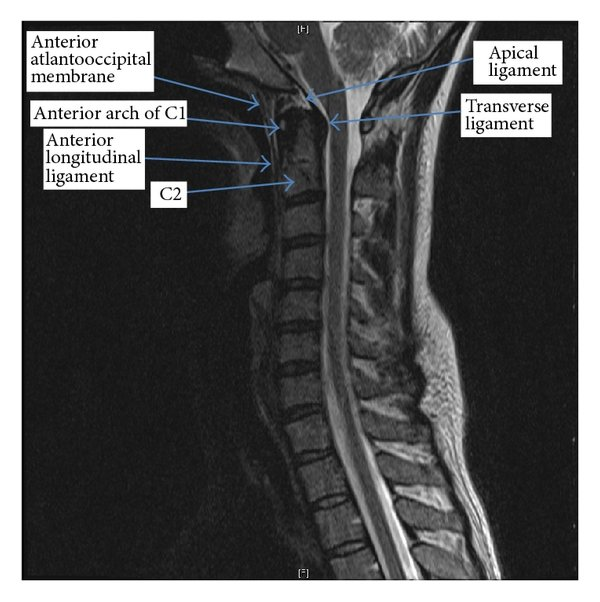
MRI assessment of traumatic cervical injury depends on understanding the anatomy and imaging characteristics of the cervical ligaments, particularly when ligamentous injury is clinically suspected. [1]
A complete evaluation also depends on understanding why the right diagnosis matters after an auto accident, since imaging findings must be interpreted alongside the history and examination.
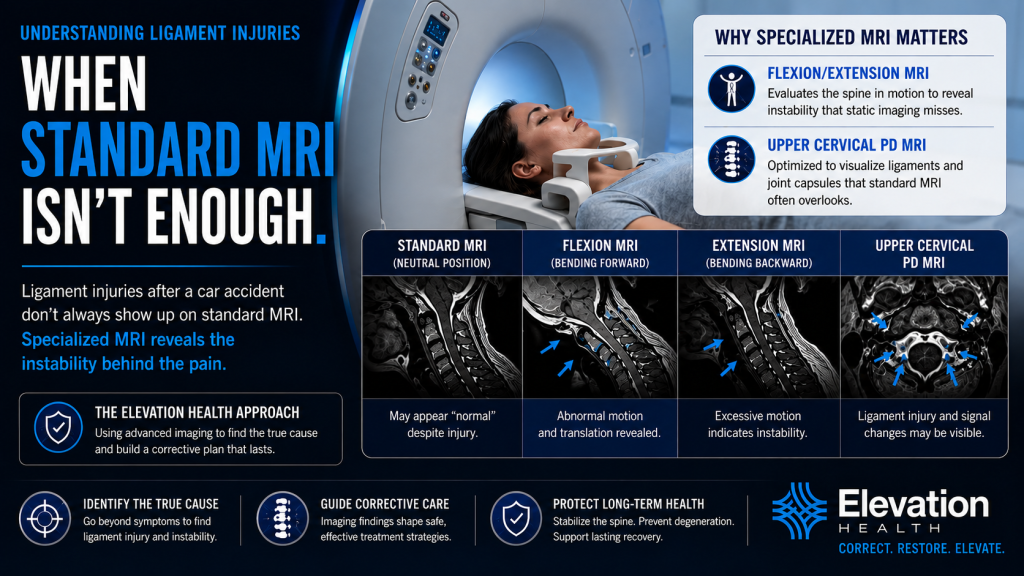
Objective diagnosis begins with choosing the right imaging for the clinical question—not simply ordering the most common MRI protocol.
Flexion/extension MRI evaluates the spine in different positions—typically bending forward (flexion) and backward (extension). This allows doctors to assess how spinal segments behave under movement.
Flexion/extension MRI can reveal:
- Abnormal joint translation
- Excessive motion between vertebrae
- Segmental instability that is not visible in neutral imaging
- Dynamic stress on the spinal cord or nerve roots
For patients injured in car accidents, this type of imaging is especially valuable because ligament injuries often allow too much motion, not too little.
If instability is present, treating the spine as if it were simply “stiff” can worsen symptoms rather than improve them.
Upper Cervical Injuries Require Specialized Imaging
The upper cervical spine—particularly the relationship between the skull, C1, and C2—is highly specialized and uniquely vulnerable to trauma. These segments rely heavily on ligaments for stability and contain dense neurological structures.
Standard cervical MRI protocols may not adequately visualize:
- Alar ligaments
- Transverse ligament
- Capsular ligaments of the upper cervical joints
This is where proton density (PD) MRI sequences become important. Choosing the right imaging for the clinical question brings clarity to the diagnostic process.
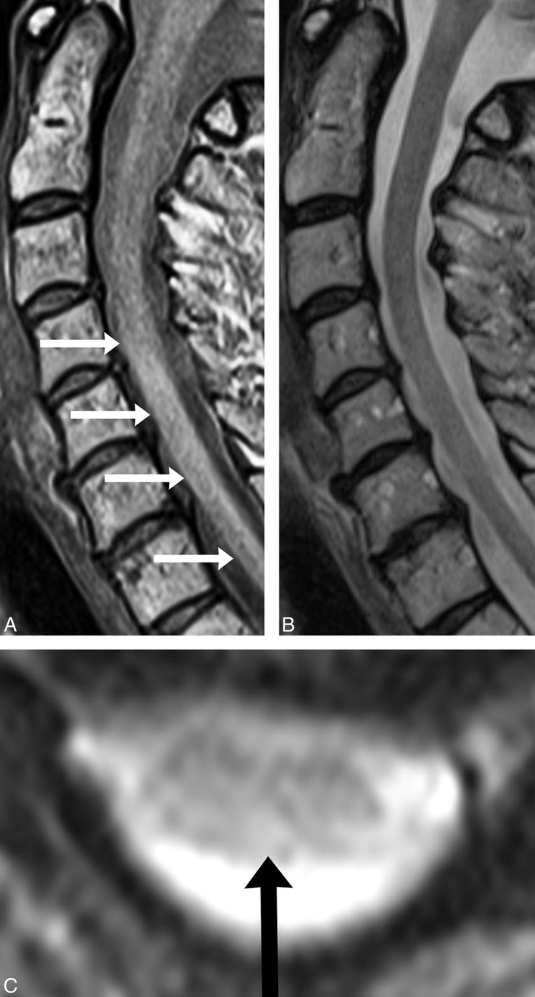
Research has reported MRI-verified lesions of upper cervical ligaments and membranes in patients following whiplash injury, supporting careful evaluation of the craniocervical region when clinically indicated. [2]
Why Proton Density (PD) MRI Matters
Proton density MRI is optimized to highlight soft tissue contrast, making it particularly useful for evaluating ligaments and joint capsules.
Upper cervical PD imaging can help identify:
- Ligament thickening or disruption
- Signal changes suggesting sprain or tearing
- Asymmetry between stabilizing structures
- Inflammatory changes related to trauma
For patients with persistent headaches, dizziness, neck instability, or neurological symptoms after a crash, these findings can be clinically significant.
Ligament Injury and Spinal Instability
When ligaments are injured, the spine may become unstable. This instability places abnormal stress on:
- Discs
- Facet joints
- Muscles
- The spinal cord and nerve roots
Over time, this can lead to:
- Chronic pain
- Recurrent flare-ups
- Early degenerative changes
- Reduced tolerance to daily activities
Identifying ligament injury early allows care to shift toward stabilization and structural correction, rather than aggressive mobilization.
“Persistent symptoms can sometimes be related to spinal instability after an auto accident, particularly when supporting ligaments have been injured.”
Experimental evidence has also demonstrated decreased cervical ligament strength following whiplash trauma, providing a biomechanical basis for persistent instability after ligament injury. [3]
Why Specialized MRI Changes Treatment Strategy
Knowing whether ligament injury or instability exists fundamentally changes how care should be delivered. For example:
- Excessive manipulation may be avoided
- Stabilization and corrective strategies are prioritized
- Rehabilitation is progressed more cautiously
- Long-term correction becomes the focus, not short-term relief
Without this information, treatment may be incomplete—or even counterproductive.
Broad labels such as sprain and strain after a car accident may not fully identify the specific tissues involved or explain persistent instability.
The Elevation Health Perspective
At Elevation Health, imaging decisions are driven by clinical findings and patient history, particularly in motor vehicle collision cases.
When symptoms persist or instability is suspected, specialized MRI options—such as flexion/extension studies and upper cervical proton density imaging—may be recommended to ensure that ligament injuries are not overlooked.
Patients are educated on:
- Why standard imaging may be insufficient
- What specialized MRI evaluates
- How findings influence corrective care decisions
Protecting Long-Term Spinal Health
Unrecognized ligament injuries can quietly alter spinal mechanics for years. Without proper identification and management, patients may experience chronic pain patterns that are difficult to resolve later.
Specialized MRI provides clarity. It allows clinicians to see beyond static anatomy and understand how trauma has altered spinal stability.
Seeing What Standard Imaging Misses
Ligament injuries are not always obvious—but their effects can be profound. When symptoms persist after a car accident, advanced imaging may be the key to understanding why recovery has stalled.
By using the right imaging for the right clinical question, care can move from trial-and-error to precision-based correction—protecting both short-term recovery and long-term spinal health.
If Symptoms Persist After an Auto Accident...
learn more about our Auto Accident Care approach and how Elevation Health evaluates injuries, imaging findings, and spinal biomechanics.
Refences
- Mantripragada S, Kannivelu A, Peh WC. “Magnetic resonance imaging of cervical ligamentous anatomy and traumatic ligamentous injuries.” Journal of Medical Imaging and Radiation Oncology. 2020;64(3):368–376.
- Kaale BR, Krakenes J, Albrektsen G, Wester K. “Head Position and Impact Direction in Whiplash Injuries: Associations With MRI-verified Lesions of Ligaments and Membranes in the Upper Cervical Spine.” Journal of Neurotrauma. 2005;22(11):1294–1302. DOI: 10.1089/neu.2005.22.1294.
- Tominaga Y, Ndu AB, Coe MP, et al. “Neck Ligament Strength Is Decreased Following Whiplash Trauma.” BMC Musculoskeletal Disorders. 2006;7:103. DOI: 10.1186/1471-2474-7-103.