
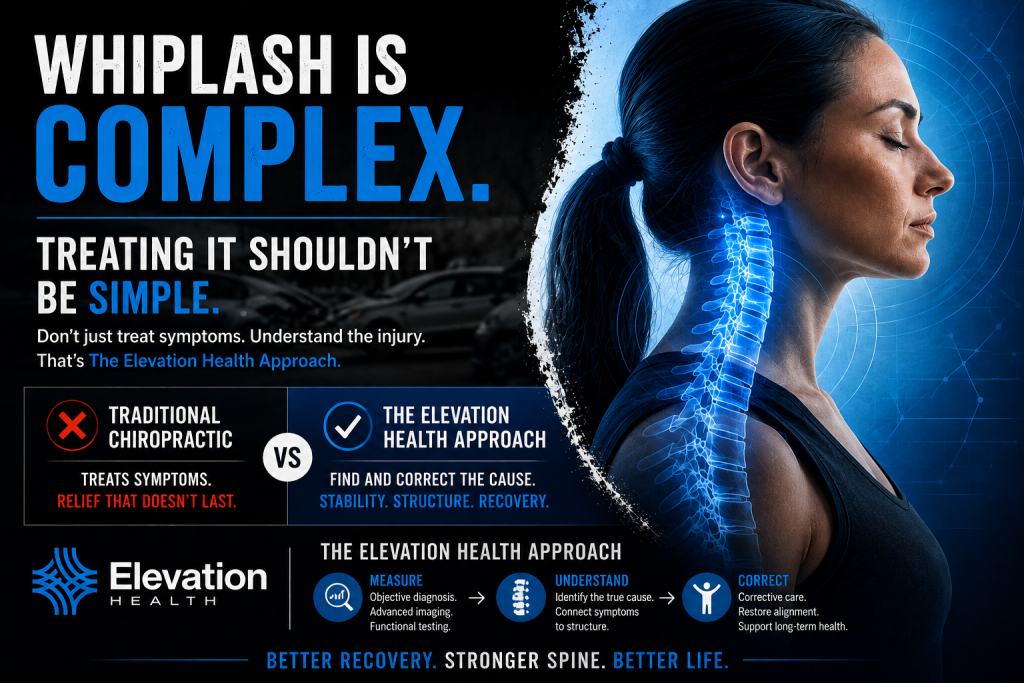
Why Whiplash Injuries Need More Than Traditional Chiropractic
Whiplash after a car accident is one of the most misunderstood and underestimated injuries we see. Many people are told their pain will resolve with time, rest, or a few chiropractic adjustments. While some improve, others develop persistent neck pain, headaches, stiffness, dizziness, or neurological symptoms that can continue for months or even years.
The reason is simple: whiplash is not just a muscle injury. It is a complex biomechanical injury that often involves damage to spinal alignment, ligaments, and joint stability—issues that traditional chiropractic care alone may not fully address.
The Elevation Health Approach to whiplash recovery emphasizes identifying the true cause of persistent symptoms before developing a treatment plan.
What Actually Happens During Whiplash
Whiplash occurs when the head and neck are subjected to rapid acceleration and deceleration forces, most commonly during rear-end or side-impact collisions. These forces exceed the normal physiological limits of the cervical spine.
During a whiplash event:
- The head is thrown backward and forward in milliseconds
- Cervical joints are forced beyond their normal range
- Ligaments that stabilize the spine are stretched or torn
- Normal spinal curves may be altered instantly
Importantly, these injuries can occur even in low-speed collisions, and symptoms may be delayed for hours or days.
Why Traditional Chiropractic Often Falls Short
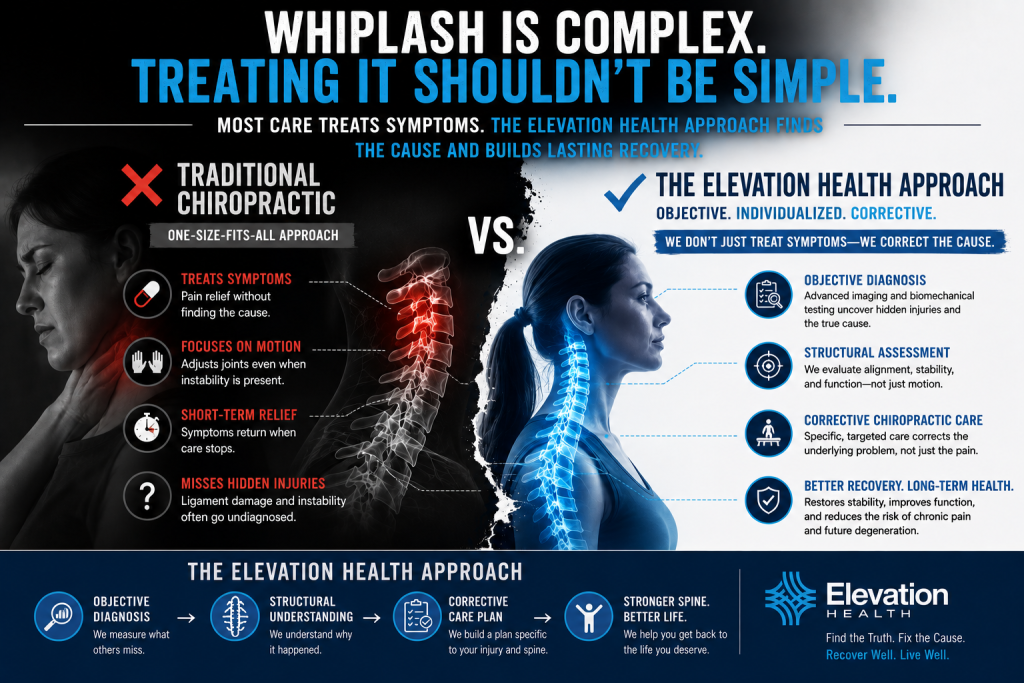
Traditional chiropractic care focuses primarily on restoring motion to restricted joints. While this can reduce pain and muscle tension, it may not be sufficient when the underlying problem is instability or altered spinal structure.
After whiplash, the spine may move too much rather than too little. If injured ligaments are not providing proper support, repeated adjustments alone may:
- Temporarily reduce pain
- Fail to stabilize injured segments
- Allow abnormal motion to persist
- Lead to recurring flare-ups
This explains why many patients feel better initially but plateau or relapse once care is reduced.
The Role of Spinal Alignment After Whiplash
One of the most common consequences of whiplash is loss of normal cervical lordosis (the natural curve of the neck). When this curve is flattened or reversed:
- Mechanical stress on discs increases
- Muscles must work harder to support the head
- Nerve tension increases
- Joint degeneration accelerates
These changes are not always visible without imaging, which is why many injuries due to whiplash after a car accident go underdiagnosed.
Why Imaging Is Critical in Whiplash Cases
X-rays and, when indicated, advanced imaging provide essential insight into the structural effects of trauma. Digital X-rays can reveal:
- Curve loss or reversal
- Forward head translation
- Segmental misalignment
In some cases, specialized imaging may be needed to assess ligament injury or instability.
Without imaging, care is often based on symptoms rather than structure—an approach that can miss the root cause of ongoing pain. Objective diagnosis begins with choosing the right imaging for the clinical question—not simply ordering the most common MRI protocol.
How CBP Addresses Whiplash Differently
Chiropractic Biophysics® (CBP), corrective chiropractic for whiplash, was designed to correct spinal alignment and posture using objective, measurable methods. In whiplash cases, CBP focuses on:
- Restoring normal spinal curves
- Reducing abnormal head and neck positioning
- Improving stability through structural correction
CBP care combines precise adjustments with mirror-image exercises and corrective traction. This approach does not simply mobilize joints—it re-trains the spine toward healthier biomechanics.
Corrective traction is particularly important after whiplash because it applies sustained forces that encourage lasting structural change rather than short-term relief.
Why Stability Matters for Healing
Ligaments heal best when they are not constantly being overstressed. If alignment is poor, injured ligaments are repeatedly strained during everyday activities such as sitting, driving, or using a phone.
By improving spinal alignment, CBP reduces abnormal forces on injured tissues, creating a more stable environment for healing. Patients often report:
- Decreased headache frequency
- Improved neck endurance
- Better tolerance for daily activities
- Fewer relapses after care is reduced
When ligament injury is suspected, The Elevation Health Approach may include specialized MRI recommendations to better understand spinal stability.
The Elevation Health Approach to Whiplash
At Elevation Health, whiplash after a car accident is approached as structural and biomechanical injuries, not just soft-tissue strains.
Care is guided by:
- Objective spinal measurements
- Trauma-informed assessment
- Structured corrective plans
- Re-evaluation to confirm progress
Patients are educated about how the injury altered their spine and why corrective care is necessary to restore long-term stability.
Preventing Chronic Whiplash Symptoms
When whiplash is treated only as a short-term pain condition, many patients are left vulnerable to chronic problems. Uncorrected alignment changes can contribute to:
- Chronic neck pain
- Persistent headaches
- Early degenerative disc disease
- Reduced tolerance for physical stress
Corrective chiropractic for whiplash recovery helps reduce these risks by addressing the mechanical consequences of trauma, not just the symptoms.
Decreasing the risk of transition to chronic pain involves objective diagnoses enabling the doctor to choose the right imaging to answer the right clinical question—not simply ordering the most common x-ray or MRI protocol.
More Than Relief—True Recovery
The greatest risk isn’t always the initial injury—it’s the years of abnormal spinal mechanics that can follow when ligament damage goes undetected. Persistent instability increases mechanical stress on discs, joints, and supporting muscles, potentially accelerating degeneration and making recovery far more difficult.
Whiplash injuries demand more than temporary pain relief. They require a thoughtful, data-driven approach that recognizes how trauma alters spinal structure and function.
Chiropractic Biophysics provides that framework—helping patients move beyond symptom management toward genuine recovery.